Global Brief: Sep 21 – Sep 27
Washington gained a veto over Arctic investment, a $30 billion tariff deal with Beijing, and a blockade that held. The pattern connecting all three.


The week in brief. President Trump and President Xi Jinping met in Washington and agreed to cut tariffs on $30 billion of goods moving in each direction, one of eight commitments they announced. The day before that visit began, the United States signed a permanent agreement with Denmark and Greenland granting American forces open-ended basing rights in the Arctic and a veto over who may invest there. The American blockade of Iranian oil held into its third month while a strike on a Saudi pipeline pushed fuel prices up. In each case, a military position was converted into a lasting legal claim.
The Week in Detail
Washington and Beijing Trade $30 Billion in Tariff Cuts for a Standing Negotiating Machine
The United States and China used a three-day state visit to lock in a set of permanent institutions, with tariff relief as the opening payment. China's foreign ministry announced the trip on September 21, giving two days' notice for a visit that ran from September 23 to 25. It was Xi's second state visit to the United States, the first since 2015.
Trump and Melania Trump met the Chinese delegation planeside at Joint Base Andrews, a departure from the usual practice of receiving visiting leaders at the White House. The welcome included a 21-gun salute and a military flyover.
The substance came on the second and third days. Both governments described eight agreed outcomes. The centerpiece was a reciprocal tariff reduction covering $30 billion of non-sensitive goods in each direction. On the American export side, the list covers farm goods, fish and seafood, logs and wood products, cosmetics and medical devices. On the import side it covers small appliances, toys, holiday decorations and children's car seats, which is to say the reduction lands on things families buy.
The more durable piece is structural. The two sides brought the U.S.-China Board of Trade and the U.S.-China Board of Investment into operation. Both were chartered at the May 2026 Beijing summit and had existed only on paper. The Board of Trade also opened a working group on agricultural market access. Alongside these, the leaders agreed to an artificial intelligence dialogue, cooperation on counternarcotics and law enforcement, and a military crisis communication channel.
Two further items stood out. Both leaders said Iran should honor its commitment not to develop nuclear weapons, and that no country or institution should charge tolls for passage through international waterways. According to the White House fact sheet, Trump also pressed for three-way arms control talks involving the United States, Russia and China. Chinese Foreign Minister Wang Yi said the two presidents have now held three in-person meetings and five phone calls since Trump's second term began.
The Arctic Agreement Gives the US Bases in Greenland and a Veto Over Foreign Money
On September 22 at United Nations headquarters, Trump signed an agreement with Danish Prime Minister Mette Frederiksen and Greenlandic Prime Minister Jens-Frederik Nielsen that makes the American military presence in Greenland permanent and gives Washington a say over foreign investment on the island. The text amends the 1951 Defense Agreement and can be changed only by mutual consent. It affirms Denmark's sovereignty and Greenland's right to self-determination, and enters into force once Danish and Greenlandic parliamentary procedures are complete.
The military provisions are specific. The United States may modernize and expand Pituffik Space Base and establish additional Defense Areas at Narsarsuaq and Mestersvig, with the option of more later. The agreement covers a Golden Dome missile defense system and stronger NATO activity in the Arctic across planning, presence, exercises and joint intelligence. Proposals for new Defense Areas run through a Permanent Committee, and disputes escalate to deputy minister and then minister level if unresolved within 90 days. Construction contracts are to go to Greenlandic firms to the maximum extent possible.
The economic provision may matter more over time. The deal creates a joint American and Danish screening process for investment in Greenland. Secretary of State Marco Rubio said it is designed to block non-NATO money, and Chinese money in particular. He said the arrangement allows as many bases as the United States needs, with at least two initially, one restarted and one built up, and that it holds regardless of any future Greenland independence vote. The White House said the agreement comes at no cost to American taxpayers.
That screen now sits on top of a European arrangement signed three weeks earlier. On September 7 in Nuuk, European Commission President Ursula von der Leyen, Nielsen and Frederiksen signed an EU-Greenland Joint Declaration, paired with a €200 million package for satellite capacity, hydropower and mining projects including Malmbjerg molybdenum and GreenRoc's Amitsoq graphite. Both Washington and Brussels are courting the same island for the same minerals, and Washington now holds the gate.
The Iran Blockade Holds While a Pipeline Strike Moves the Oil Price
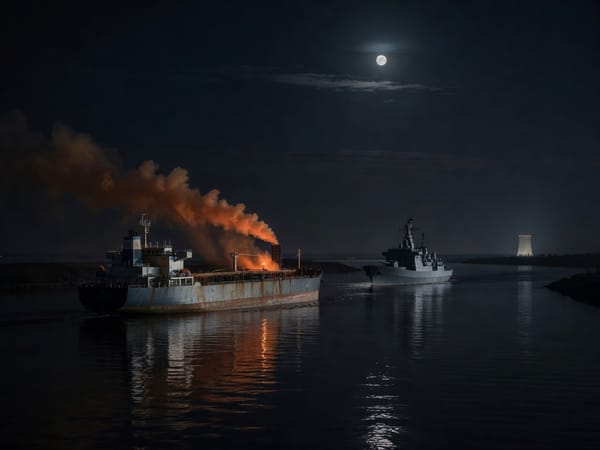
The American campaign to cut off Iranian oil revenue continued without visible change, and the week's price movement came from somewhere else. Rubio said on September 22 that the United States maintains a total blockade, that Iran has not shipped oil out for weeks, that more oil is moving through the Strait of Hormuz as the Navy clears mines and escorts ships, and that sanctions loopholes are being closed as they are found.
Those are the administration's own figures. They follow Operation Economic Outcast, the Treasury campaign launched on August 24 that applied sanctions across Iranian digital assets, technology, gold, aviation and shipping, and designated more than 60 entities, individuals and vessels. On August 29, Central Command said roughly 1,500 commercial vessels carrying 750 million barrels had transited the strait under American protection and that Iran had exported no oil since the blockade resumed in July.
The price move had a different cause. Rubio attributed the bulk of the previous fortnight's increase to a Houthi attack on a Saudi pipeline that forced Saudi Arabia to shut it down, and described the Houthis as an Iranian proxy. Markets priced in reduced Saudi supply. Drivers felt it at the pump, which is the mechanism by which a strike on a pipeline in the Arabian Peninsula reaches an American commute.
Diplomatic movement was limited. Rubio said Trump is willing to meet the Iranian president but that nothing is scheduled. Xi used his White House talks to urge both governments back to negotiation and to the Islamabad Memorandum of Understanding. The International Atomic Energy Agency reported on September 7 that it has had no access to declared Iranian nuclear material for more than a year, which its director general called a serious proliferation concern.
Rubio also aired a grievance about the alliance. He said a handful of NATO members refused American use of bases on their territory during the Iran operation, and argued that an alliance whose bases cannot be used for power projection loses its central benefit.
What It Means
The three stories share a mechanism. In each, a temporary military or economic advantage was written into an instrument designed to outlast the administration that won it. The Greenland agreement is open-ended and amendable only by mutual consent. The Venezuelan oil concessions announced in August run for 100 years. The China boards are standing bodies with working groups and schedules. Tariff rates change with each election. Treaty text and equity stakes do not.
The week also showed Washington running two China policies at once without treating them as contradictory. At the White House, China was a partner on artificial intelligence governance, narcotics enforcement and military deconfliction. At the United Nations two days earlier, the same administration signed a treaty whose explicit purpose is keeping Chinese capital out of the Arctic. Cooperation at the top and exclusion at the perimeter are being pursued as complementary, and Beijing signed the first without publicly objecting to the second.
Allies are being handed narrower choices. Brussels spent September building its own Greenland relationship and now finds that relationship subject to a joint American and Danish screen. The Department of War's $1.55 billion rare earth commitment in Brazil in August and the Greenland investment veto serve the same goal of a mineral supply chain that does not pass through China, and European partners are being enrolled in it rather than consulted about it. Rubio's complaint about denied base access points the same direction, toward a definition of alliance measured by access granted.
One caution runs through the week. Much of what is known about the Iran blockade, the Venezuela deal and the Greenland terms comes from the governments that negotiated them, and the independent verification is thin. The IAEA, the body whose job is to check Iranian nuclear claims, has been locked out for over a year.
What to Watch Next Week
The Greenland agreement meets its parliaments: The deal enters into force only after Danish and Greenlandic parliamentary procedures conclude, and Greenlandic politics has an active independence current. Watch for a Greenlandic parliamentary timetable, for opposition statements on the investment screening clause, and for whether Brussels comments publicly on how its €200 million package interacts with the new screen.
The tariff cuts get a schedule or they do not: The $30 billion reduction was announced as a consensus on recommendations rather than as rates in force. Watch for a Federal Register notice or Chinese customs announcement naming the product lines, for the first Board of Trade working group meeting on agricultural access, and for whether either side attaches conditions before implementation.
Hormuz risk shifts from Iran to the Gulf littoral: The week's price move came from a strike on Saudi infrastructure, not from the blockade itself. Watch for further Houthi attacks on Saudi energy assets, for Saudi statements on pipeline repair timelines, and for whether the no-tolls language in the US-China statement draws a response from Tehran.
Generated from structured event data extracted from official government and institutional sources. Not financial or legal advice.