Global Brief: Sep 14 – Sep 20
Congress made the Russia and Iran sanctions campaign permanent, the IAEA lost track of Iran's uranium, and oil demand fell for the first time since COVID.


The week in brief. The US turned its sanctions campaign against Russia and Iran into permanent law, fixing in statute measures that until now rested on executive orders. Europe's Commission president proposed a joint defence purchasing instrument, an economic alliance with Canada, and an age limit for social media. The nuclear inspectorate said it can no longer account for Iran's enriched uranium. Global oil demand fell for the first time since the pandemic. Governments are reaching for economic tools, and the costs are showing up in fuel markets and in the machinery of inspection.
The Week in Detail
Congress Writes the Russia and Iran Sanctions Campaign Into Permanent Law
The pressure campaign Washington has run through executive orders for the past year became statute on Friday. President Trump signed H.R. 5334, the Lindsey O. Graham Sanctioning Russia and Iran Act of 2026, which authorizes and expands statutory sanctions, tariffs and prohibitions targeting Russia and extends existing sanctions on Iran.
The legal form matters as much as the contents. An executive order lasts as long as the president who signs it, and a successor can revoke one with a signature. A statute takes an act of Congress to undo.
Four days earlier the Treasury's Office of Foreign Assets Control (OFAC), coordinating with the State Department, designated VTB Bank, one of Russia's largest financial institutions. The action was taken under Executive Order 13902, which targets Iran's financial sector rather than Russia's. OFAC said VTB opened offices in Iran, built correspondent banking relationships with sanctioned Iranian banks, moved billions of dollars in frozen Iranian assets, and created a ruble-rial settlement system. Treasury Secretary Scott Bessent said Treasury would continue to target those providing financial support to the Iranian regime, and the department warned foreign banks to cut VTB relationships immediately.
The designation used an Iran authority against a major Russian bank, joining the two files. It follows Operation Economic Outcast, the campaign Bessent announced on 24 August with sectoral determinations covering digital assets, technology, gold, aviation and shipping, and more than sixty designations in a single day.
Pressure eased in one direction. On 15 September the President determined that Venezuela should no longer be designated as having failed demonstrably to meet its drug control commitments, citing cooperation from the interim government under Delcy Rodríguez and the elimination of Tren de Aragua leader Niño Guerrero. The determination described the arrest and removal of former leader Nicolás Maduro as background.
Twelve days before that reversal, the White House announced an agreement giving the US government majority control and guaranteed low-cost off-take rights over more than 65 billion barrels of Venezuelan proven reserves.
Von der Leyen Asks Europe to Buy Defence, Partners and Child Safety Rules Together
The European Commission president used her annual State of the Union address to propose that Europe purchase jointly what its member states have so far bought separately or not at all. Ursula von der Leyen announced a new European Instrument for Strategic Enablers, aligned with NATO, to procure air and missile defence, strategic transport, air-to-air refuelling, space and cyber capabilities. Her argument was one of scale: only together, she said, does Europe have the size to deliver these systems.
She also proposed moving beyond the Comprehensive Economic and Trade Agreement (CETA) to an "Alliance for the Future" with Canada, spanning manufacturing, technology, integrated defence industrial bases, Arctic projects, energy, critical minerals, artificial intelligence, quantum, cyber and economic security. She went further and proposed opening the door for Canada to become the EU's first associate member, a category that does not currently exist.
On Ukraine she promised the strongest support yet for the coming winter: humanitarian aid, reinforced power and heating supplies, strengthened air defences, and approved purchases of American Patriot interceptor missiles. The EU will develop a modular missile-defence system with Ukraine centred on the Freya project, funded through a new programme drawing on remaining money from SAFE, the bloc's defence financing instrument. A read-out of her call with President Zelenskyy the following day confirmed that arrangement.
The urgency has a recent source. On 2 September the German government attributed an attempted attack on cargo planes at Leipzig/Halle Airport, using military-grade material, to Russian operatives working on EU soil. Von der Leyen called it a new escalation.
The Commission's College of Commissioners then adopted the EU KIDS Act on 17 September. It would bar social media for children under 13, set a minimum age of 15 for independent accounts, and give 13 to 15 year olds parent-supervised "mini accounts" capped at an hour a day.
Platforms serving under-18s would face safety-by-design duties, including bans on infinite scroll, overnight push notifications and emotionally dependent AI chatbots. The burden of proof is reversed, so large platforms must demonstrate their services are safe rather than wait to be found unsafe. It now goes to the European Parliament and Council.
The Nuclear Inspectorate Says It Cannot Account for Iran's Enriched Uranium
The International Atomic Energy Agency (IAEA) told its member states this week that it no longer knows how much enriched uranium Iran holds. Opening the Agency's 70th General Conference in Vienna on 14 September, Director General Rafael Mariano Grossi reported that oversight of Iran's programme deteriorated through 2026 after renewed attacks, that inspectors were withdrawn, and that there has been no in-field verification for more than six months.
The Agency has lost what inspectors call continuity of knowledge, the unbroken chain of measurement and surveillance that lets them state material has not been moved. Once that chain breaks it cannot be rebuilt by arriving later and counting. Grossi called the situation a serious proliferation concern and urged a return to diplomacy and negotiations.
He had said something similar a week earlier. In a 7 September report to the Board of Governors, Grossi noted that more than a year had passed since the Agency lost continuity of knowledge on Iran's declared inventories of low-enriched uranium and uranium enriched to 60 percent, at facilities affected by military attacks in June 2025.
The same speech carried an opposite result. Grossi announced that the Agency has resolved outstanding safeguards questions about Syria's past nuclear activities, following Syrian cooperation and access to the Dair Alzour site. That file had been open for nearly two decades.
In Ukraine, Grossi negotiated a seventh ceasefire at the Zaporizhzhya plant, allowing demining and repair work to restart the Ferosplavna-1 power line and restore the outside electricity the reactors need for cooling. The plant has lost offsite power ten times since June, and its emergency generators are depleted. Agency teams at Ukrainian nuclear sites reported drone activity in their monitoring areas that week: 48 at Chornobyl, 35 at South Ukraine with some as close as 1.5 kilometres, 13 at Khmelnytskyy and 8 at Rivne.
Global Oil Demand Fell for the First Time Since the Pandemic
Oil demand worldwide contracted in the second quarter of 2026, and the cause was not a recession. The International Energy Agency (IEA) reported on 18 September that demand fell by 5.3 million barrels a day against the same quarter last year, the first quarterly decline since COVID, driven by higher prices and product shortages. China's apparent consumption ran 1.7 million barrels a day below February levels, and its seaborne crude imports dropped from 11.5 million barrels a day to 6 million in June.
This is demand destruction rather than weak growth. Consumption falls when fuel is unavailable or priced out of reach, whether or not buyers want it to. The IEA now expects global demand to contract by 2.5 million barrels a day across 2026, with the Middle East and Asia accounting for 80 percent of the fall.
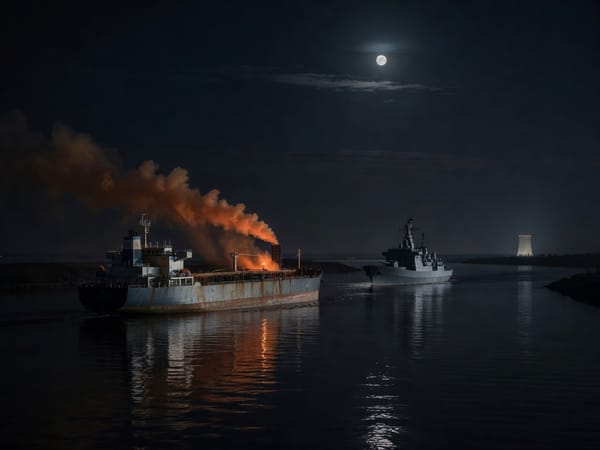
Two supply-side campaigns sit behind those numbers. Iran has exported no oil since the Strait of Hormuz blockade resumed in July, according to US Central Command, which said in late August that nearly 1,500 commercial vessels carrying 750 million barrels had transited under American protection and that 75 vessels attempting to break the blockade were turned away.
The second campaign targets refining rather than crude. The IEA reported that Ukraine hit a Russian refinery on average once every three days through the first eight months of 2026, increasingly aiming at secondary units such as fluid catalytic crackers and hydrocrackers, the equipment that converts crude into diesel and petrol. The 7 July strike on Gazprom Neft's Omsk refinery, Russia's largest at 450,000 barrels a day, landed roughly 2,500 kilometres from the Ukrainian border. By late August only five major Russian refineries remained untouched, all of them in eastern Siberia or the far east.
Crude in the ground is not fuel in a tank. Refineries stand between the two, and they are what drivers and freight operators actually buy from.
What It Means
The week's largest decisions were about instruments rather than objectives. Congress converted a sanctions campaign into statute. Brussels proposed buying military capability jointly instead of nationally. Washington traded a drug-control designation for a commercial position in Venezuelan oil.
None of these governments changed what they want, only the machinery they intend to get it through.
Permanence is the variable they are all working on. A statute outlives the administration that wanted it. So does an associate-membership category and a procurement instrument with its own budget. Several of this week's moves are attempts to make current policy expensive for a successor to reverse.
The costs of the economic approach are now visible in two places. Oil demand is falling because fuel is scarce and expensive, which is what a blockade and a sustained refinery campaign produce. Households and freight operators in Asia and the Middle East are paying for that directly. Meanwhile the system that would tell the world whether Iran's uranium stayed where it was has stopped working, not only because Iran withheld access but because the facilities holding the material were attacked and the inspectors left.
The clearest illustration sat inside a single speech in Vienna. Syria's file closed after nearly twenty years because a government granted access to a site. Iran's went dark.
Verification is not a capability an international agency holds on its own. States grant it, and it can be withdrawn far faster than it can be rebuilt.
What to Watch Next Week
Secondary sanctions reach a bank in a third country: Treasury told foreign financial institutions to cut VTB relationships immediately, and the new statute widens the authorities available for acting on that warning. Watch for a designation of a bank that is neither Russian nor Iranian, for public guidance naming specific jurisdictions, and for banks in China, Turkey or the Gulf announcing they have ended Russian correspondent arrangements.
Member states question the Canada association proposal: Von der Leyen proposed associate membership without naming a legal route to it. Watch for Council statements asking about the legal basis, for reaction from capitals that resisted earlier enlargement rounds, and for whether the Commission publishes a timetable or points to a treaty provision.
Iran's file moves from the conference floor to the Board of Governors: Grossi called for a return to diplomacy while reporting he can verify nothing. Watch for a Board resolution setting a deadline for access, for any Iranian offer of partial inspection, and for whether the Agency publishes an estimated inventory figure derived from pre-attack measurements.
Generated from structured event data extracted from official government and institutional sources. Not financial or legal advice.