Global Brief: Oct 5 – Oct 11
A missile strike on Riyadh's airport tightened world diesel markets, Washington sanctioned a court, and Brussels hedged on China. The week's common thread.


The week in brief. A missile strike on Riyadh's main airport killed twelve people and tightened global diesel markets already strained by war in the Gulf. The United States sanctioned the International Criminal Court as an institution, after a year of targeting individual judges. Europe bought rare earth supplies from China while funding 46 mining projects at home to need fewer of them. In each case governments reached for money and legal designations rather than force, and the costs showed up at fuel pumps far from any battlefield.
The Week in Detail
A Missile Strike in Riyadh Pushes Already Tight Diesel Markets Tighter
The deadliest attack of the week hit civilian infrastructure in Saudi Arabia, and the world's main energy watchdog cited it a day later as part of why diesel is getting scarce.
King Khalid International Airport in Riyadh was struck by a missile on October 10. Twelve people were killed, including citizens of Saudi Arabia, Bangladesh, Egypt, Jordan, Syria, Palestine, Sudan and the United States, and more than 300 were injured.
A day later, International Energy Agency (IEA) Executive Director Fatih Birol wrote to member governments about tightening global diesel markets, pointing to renewed attacks on civilian and energy infrastructure in Saudi Arabia, the Riyadh airport among them.
The strain is not new. A Houthi attack on Saudi Arabia in early September, which Secretary of State Marco Rubio called the work of an Iranian proxy, was followed by the shutdown of the Saudi East-West pipeline carrying crude to the Red Sea port of Yanbu. Oil moving through the Strait of Hormuz averaged 7.6 million barrels a day in August, which IEA data put 13.1 million below pre-war levels.
Diesel moves freight and runs harvest equipment, so its price reaches grocery shelves. President Trump signed an executive order on October 5 waiving the off-road restriction on dyed diesel, letting truckers buy the tax-free fuel for highway use and deferring the federal excise tax of 24.4 cents a gallon through the end of the year. According to a White House release, that is roughly $60 on a 250-gallon fill and over $100 where states match the federal action. The order came five days before the Riyadh strike, and the White House attributed high prices to the war in Ukraine and limited refining capacity.
Europe's central bank has been answering the same pressure. Also on October 5, European Central Bank (ECB) Chief Economist Philip Lane said the ECB had raised its policy rate from 2.00 per cent to 2.50 per cent across its June and September projection rounds, and called the increase prudent given the energy supply shock. He stressed that the Governing Council is not on a pre-committed path. For euro area households, that half point is a larger mortgage payment.
Treasury Says Another Round of Shipping Sanctions Has Nearly Finished Iran's Shadow Fleet
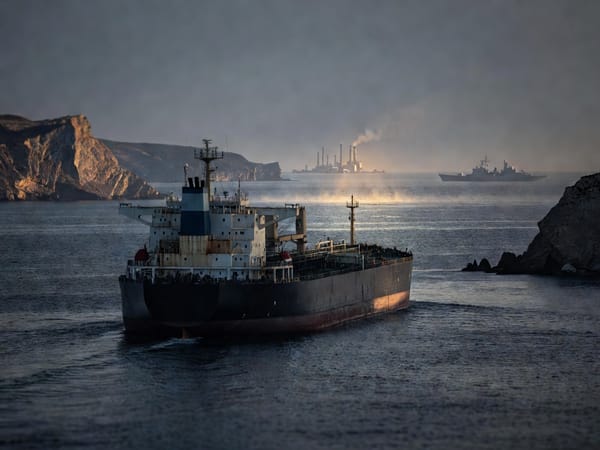
The United States designated dozens of tankers and companies carrying Iranian oil on October 8, and Treasury said the action neutralized the vast majority of what is left of Iran's shadow fleet, the ageing tankers that disguise their identity and paperwork to move sanctioned crude.
The Treasury Department's Office of Foreign Assets Control (OFAC) designated 17 shadow fleet vessels and 18 associated companies under Executive Order 13902, which targets Iran's petroleum and petrochemical sectors. The State Department acted the same day against ten entities, six individuals and five vessels under Executive Order 13846. OFAC's additions to its Specially Designated Nationals list that day reached across India, Turkey, the United Arab Emirates, China, Hong Kong, the Marshall Islands and the UK, with tankers flagged to eight further jurisdictions.
Treasury Secretary Scott Bessent said the department is "starving the tyrannical regime in Tehran of the money it uses to wage war in the region."
The campaign behind this began in August. Bessent launched Operation Economic Outcast on August 24 at the President's direction, with sectoral determinations covering digital assets, gold, aviation and shipping. On September 8, OFAC hit 36 aviation targets, including 27 Iranian airlines. On September 29, it designated ten individuals and entities for procuring weapons components for Iran's defence ministry.
The claim that the fleet is nearly gone is Treasury's own. So is the related August statement from US Central Command that Iran had exported no oil since the blockade resumed in July and that 75 vessels attempting to break it were turned away. What is measured independently flatters no one: the IEA reported that global oil demand fell by 5.3 million barrels a day year on year in the second quarter, the first quarterly decline since the pandemic.
The US Sanctions the ICC Itself, and Opens a Path to Removing a Fed Governor
Two American actions this week pointed coercive tools at bodies designed to sit outside day-to-day political direction: an international court and the central bank.
On October 9, Rubio announced that the United States was imposing sanctions on the International Criminal Court (ICC), banning transactions with it in order to cut off its resources and, in his words, cripple its ability to operate. The court was designated under Executive Order 14203, and all ICC property and interests in property in the United States, or held by US persons, are blocked. Rubio said Washington had deferred the designation for more than a year while waiting for the court and its member states to address US concerns, and that room remains for a negotiated solution.
The step up matters. In August, the same executive order was used against two people: ICC President Tomoko Akane and Senior Trial Lawyer Abdoulaye Seye. In September, according to a White House release, sanctions followed the court's arrest warrants for Israeli leaders including Prime Minister Benjamin Netanyahu. This week the target was the institution.
The European Union objected on both days. Its October 9 statement expressed deep regret and committed to working with the 125 states party to the Rome Statute to preserve the court's independence, and noted that the US measures carry a six-month delay before they apply. A statement from the EU High Representative the next day called them unacceptable attacks or threats against the court and its elected officials.
Separately, on October 7, the President signed a memorandum establishing a committee of inquiry into allegations that Federal Reserve Governor Lisa Cook made false statements on one or more mortgage instruments. The committee is to report on whether there is cause for Cook's removal under 12 U.S.C. 242, as construed in Trump v. Cook. Nothing in the record ties the two actions together. The parallel is in the instrument, not in any stated intent.
Brussels Buys Rare Earth Access From Beijing and Funds 46 Projects to Need Less of It
The European Union made two moves on critical minerals on the same day, one that deepens its reliance on China and one meant to reduce it.
In Beijing, Trade Commissioner Maroš Šefčovič closed the second round of EU-China Trade and Investment Consultations with Commerce Minister Wang Wentao and Vice Premier He Lifeng. A joint statement published by China's Ministry of Commerce listed 16 points of consensus covering trade balance, export controls, intellectual property and World Trade Organization reform. China agreed to keep facilitating export licences for rare earths and permanent magnets through a fast-track mechanism, and both sides agreed to give advance warning when items are added to or removed from control lists.
The package went further than minerals. The two sides also agreed to moderate Chinese exports of hybrid and plug-in hybrid vehicles to the EU, potentially cutting them by more than half, and to lower Chinese tariffs on car parts, olive oil and footwear, worth about €225 million. A third round is set for March 2027.
The same day produced the opposite bet. The European Commission selected 46 new strategic projects under the Critical Raw Materials Act, drawn from 171 applications across 16 member states: 8 extraction projects, 11 processing, 19 recycling and 8 integrated. They cover 15 of the EU's 17 strategic raw materials, among them lithium, nickel, cobalt, graphite, tungsten and rare earths. The portfolio now stands at 93 projects inside the Union and 13 in partner countries. Executive Vice-President Séjourné presented the announcement as a step toward industrial sovereignty and less dependence on China.
Rare earths and permanent magnets are what make electric motors, wind turbines and guided weapons work, which is why a licensing queue in one country sets factory schedules in another. Note the Commission's own breakdown: recycling is the largest category, at 19 of 46 projects. New European mines are slow and contested. Reuse is the part Brussels can move quickly.
What It Means
The common instrument this week was a list, not a deployment. Treasury and the State Department added tankers and trading companies to a sanctions register, and then added a court. The White House set up a committee to determine cause for removing a central banker. Each works by cutting off access to something administrative: dollars, documentation, or office.
The Gulf energy shock has now finished travelling. It began as a shipping problem in a narrow waterway and surfaced this week as a deferred excise tax for American truckers and a half-point policy rate in the euro area. Governments described these differently, one as relief at the pump and the other as prudence in the face of an energy supply shock. Both are domestic answers to the same disrupted barrel.
A third pattern matters more and is harder to measure. Institutions built to be slow and insulated spent the week being pulled toward the tempo of the governments around them. The ICC had its assets blocked. A Federal Reserve governor became the subject of a presidential inquiry. The ECB's chief economist, on where rates go next, answered by refusing to pre-commit, which is a defence of institutional discretion stated out loud.
Europe's response is to hedge rather than choose. On one day it signed a licensing arrangement with the supplier it says it wants to depend on less, and funded a portfolio aimed at that same dependence. That is less indecision than an admission of timelines: the licences work this quarter, the mines and recycling plants work later this decade.
What to Watch Next Week
Diesel Becomes a Political Problem in More Than One Capital: The IEA has now written to member governments about tightening diesel markets, and the US has already deferred a federal fuel tax. Watch for further IEA communications to members, for other governments matching or extending fuel tax relief, and for whether Saudi bypass export routes recover.
Allies Decide Whether to Comply With the ICC Designation: The EU noted a six-month delay before the US measures apply, and Rubio said room remains for a negotiated solution, so the next move belongs to the court's backers. Watch for statements from the 125 Rome Statute states, for European banks restricting ICC transactions ahead of the deadline, and for changes to the court's budget or staffing.
The Cook Inquiry Produces a Finding: The committee is tasked with reporting to the President on whether cause exists for removal, and the memorandum is to be published in the Federal Register. Watch for that publication, for the committee's report, and for movement in Treasury yields that would show markets pricing in a less independent Fed.
Generated from structured event data extracted from official government and institutional sources. Not financial or legal advice.