Global Brief: Oct 26 – Nov 1
Canada took a path into the EU's institutions the same week Washington's import bans on Canadian goods bit. What links that to Lagarde's exit from the ECB.


The week in brief. Canada agreed to move closer to the European Union than any country outside Europe has ever been, just as American import bans on Canadian goods took hold. Christine Lagarde announced she will leave the European Central Bank in February, part way through a cycle of interest rate rises. China's Communist Party confirmed the expulsion of senior officials including the army's second-ranking officer. In each case, commitments that run for years were made by institutions whose own leadership is changing.
The Week in Detail
Canada Takes a Path Into Europe's Institutions as US Import Bans Bite
At the 21st EU-Canada Summit in Montréal on 30 October, the two sides launched an "Alliance for the Future" and set out a route for Canada to become the European Union's first associate member, the closest institutional relationship the bloc has ever offered a country it does not intend to admit.
Commission President Ursula von der Leyen called the model "association without accession." European Council President António Costa and Canadian Prime Minister Mark Carney described it as an "ever-closer association" covering six strategic sectors.
The specifics are unusually concrete for a summit declaration. Costa said Canada became the first non-European country to join SAFE, the EU's defence industrial programme. The two sides announced a digital trade agreement to sit alongside the Comprehensive Economic and Trade Agreement (CETA), an artificial intelligence partnership, and an agreement integrating Canada into Europe's supercomputing infrastructure so Canadian researchers can train models on European machines. They also agreed to build a single space for strategic supply chains covering energy, semiconductors and critical raw materials, and joint Arctic projects that von der Leyen framed as a response to Russia rebuilding its Arctic military footprint.
None of this was improvised. Von der Leyen proposed both the alliance and Canadian associate membership in her 16 September State of the Union address. What changed in the weeks between was the North American trade relationship.
Canada announced an additional $27.6 billion in tariffs on US goods in late August, including a 50 percent tariff on American steel and aluminium. On 8 September President Trump signed five proclamations under Section 338 of the Tariff Act of 1930 banning certain Canadian dairy, alcohol and motor vehicle products outright, effective 29 September, applying regardless of origin under the United States-Mexico-Canada Agreement (USMCA).
A Canadian steel mill or distillery lost access to its largest export market in September. Montréal is the beginning of a second one.
Lagarde Will Leave the ECB in February, Mid-Way Through a Rate-Raising Cycle
Christine Lagarde informed the European Central Bank's Governing Council and European Council President António Costa on 29 October that she will step down on 7 February 2027, before her term ends, leaving the ECB and the Eurosystem without a permanent head in the middle of a tightening cycle.
That cycle is recent and contested. The Governing Council raised the three key ECB interest rates by 25 basis points in June and again at its 9 and 10 September meeting, lifting the deposit facility rate from 2 percent to 2.50 percent.
The stated reason was energy. Euro area inflation stood at 3.3 percent against a 2 percent target, which Lagarde attributed in a 12 September interview to a long-lasting shock from the conflict in the Middle East and the destruction of refining capacity, feeding through from energy into all prices. She acknowledged the increases risk slower growth.
Rate decisions are abstract until a payment changes. Households on variable-rate mortgages in Ireland and Spain have been paying more since the summer, and small firms rolling over credit lines are doing the same.
Chief Economist Philip Lane said in early October that the Council is not on a pre-committed path and will decide meeting by meeting. Whoever replaces Lagarde inherits that open question, along with a digital euro now in trilogue negotiations and targeted for a first issuance in 2029.
Beijing's Plenum Confirms Expulsions That Began With the Army's Second-in-Command
The 20th Central Committee of the Communist Party of China closed its fifth plenary session in Beijing on 29 October by adopting a resolution on Party self-governance and confirming the expulsion of a group of senior officials, formalising removals that in the military's case had already taken effect two months earlier.
The plenary deliberated reports from the Central Commission for Discipline Inspection and the Central Military Commission on what the communique called grave violations of discipline and law by dozens of senior officials. It confirmed the expulsion from the Party of figures including Ma Xingrui, Zhang Youxia, Liu Zhenli and Yi Huiman, and the removal of Li Yunze from his Party position.
Zhang Youxia was vice chairman of the Central Military Commission, ranking second only to Xi Jinping in the military chain of command. Liu Zhenli sat on the same commission. The National People's Congress Standing Committee voted to strip both of those state posts on 28 August, so the plenum was ratifying a decision the Political Bureau had already made rather than announcing a new one.
Xi Jinping delivered the main address and the explanatory remarks on the draft resolution, which carries the title Resolution on Certain Major Issues concerning Persevering with Full and Rigorous Party Self-Governance and sets out plans for anti-corruption work, organisation, discipline and oversight. The communique places the expulsions inside that campaign.
There was a signal in August. The Central Commission for Discipline Inspection held its own sixth plenary session on 22 August and called specifically for enforcing discipline in leadership transitions.
Europe Commits €45 Billion More to Ukraine as Zaporizhzhya Runs on One Power Line
The European Union set out its financing for Ukraine's 2027 war effort in the same week that United Nations investigators told the General Assembly's Third Committee that Russian strikes on Ukrainian energy infrastructure constitute war crimes, and the International Atomic Energy Agency (IAEA) reported a plant worker killed by a drone at Zaporizhzhya.
On 26 October the Council of the EU adopted eight decisions under the European Peace Facility mobilising €4.9 billion for Ukraine, of which €4.7 billion reimburses member states for military aid already delivered and €230 million funds the EU Military Assistance Mission. That implements a political agreement reached on 25 September and brings total support under the facility to €10.8 billion.
Four days later the Commission proposed the remaining €45 billion of the €90 billion Ukraine Support Loan for 2027: up to €13.3 billion in budget support split between the Ukraine Facility and Macro-Financial Assistance, and €31.7 billion for Ukraine's defence industrial capacity. Budget support is conditioned on rule of law, anti-corruption and economic resilience, and the proposal now goes to the Council. Canada agreed to participate in the loan at the Montréal summit.
The investigators' findings explain what the money is buying against. Erik Møse, who chairs the Commission of Inquiry on Ukraine, said Russian forces had intensified attacks on energy infrastructure, disrupting heating, electricity, gas and water as temperatures fell to minus 21 degrees. The Commission concluded that Russian authorities committed war crimes by intentionally attacking civilian objects, and found that Russian agents had trafficked nationals of 29 countries into military service. Casualties in September were up 85 percent on the same month last year.
At Zaporizhzhya, Europe's largest nuclear plant, a welder in the centralised repair workshop was killed by a drone on 29 October. Director General Rafael Grossi called for maximum military restraint. The plant now depends on a single 330 kV line for essential nuclear safety functions, because the main 750 kV Dniprovska line has been out since March. The IAEA is negotiating a ninth localised ceasefire to repair it.
What It Means
The instrument of choice this week was access to institutions. Brussels did not win Canada over with a tariff cut. It offered a seat inside its own machinery: a defence procurement programme, a supercomputing network, a path to a membership category that does not yet exist. Washington's instrument in the same period was the reverse, denying access through Section 338 import bans on Canadian goods and through Treasury sanctions on Rwanda's Ministry of Defence and a Rwandan bank for supporting the M23 armed group in eastern Congo.
Both approaches only work if they last, and durability was exactly what the week called into question. The €45 billion tranche reaches into 2027 and depends on reform conditions being met year after year. Canadian association is a multi-year legal build with no treaty text yet.
Yet the ECB will change president in February, and Beijing has just removed senior figures including the officer ranked second in its military command. Long commitments are being signed by institutions whose own leadership is unsettled.
The same guarantee-and-coordinate pattern showed up outside Europe. The Commission launched the T-MED platform on 26 October with €4.5 billion in guarantee capacity to pull private capital into Mediterranean renewables. The foreign ministers of the United States, Australia, India and Japan met in Atlanta on 31 October and issued a joint statement on supply chains, critical minerals and maritime rights in the Strait of Hormuz and the Red Sea.
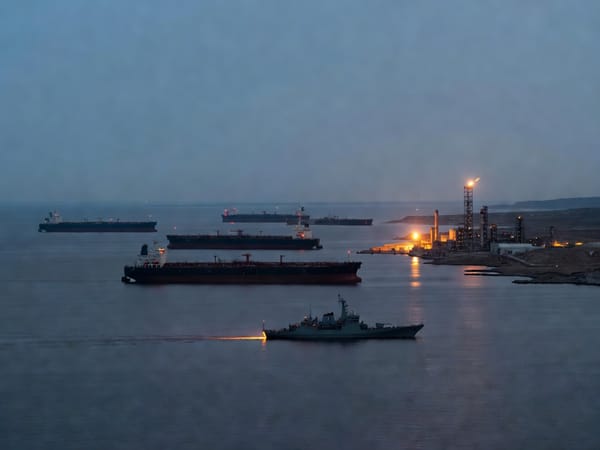
On that same day Secretary of State Marco Rubio said Iran is openly attacking commercial vessels in those waters and that US Central Command has been defending shipping almost nightly, with President Trump yet to decide on renewed strikes. The economic architecture is being laid over a security situation that is still moving.
One divergence is worth watching closely because it will land on company balance sheets. Securities and Exchange Commission (SEC) Chairman Paul Atkins said on 30 October the Commission has proposed rescinding the previous administration's climate disclosure rule and rescinding Rule 14a-8 on shareholder proposals, arguing the question belongs to the states where companies are domiciled. Three days earlier the European Commission presented its Climate Resilience Framework, which it described as the EU's first concrete legislative framework on climate resilience, identifying 100 vulnerable territories and establishing a Climate Insurance Alliance. A multinational reporting in both places now faces rulebooks heading in opposite directions on the same physical risk.
What to Watch Next Week
The ECB succession becomes a political contest: Lagarde's 7 February departure triggers the process for appointing a successor, and national governments will try to lock in a candidate early. Watch for member states publicly floating names, for any statement from Costa on the timetable, and for whether the Governing Council signals that policy will hold steady through the handover.
The Council moves or stalls on the €45 billion Ukraine tranche: The Commission's proposal needs Council adoption before disbursements can begin in early 2027, and its budget support component carries conditions that have slowed payments before. Watch for a Council agenda item on the implementing decision, for Canada's contribution being given a legal form, and for whether the IAEA secures its ninth localised ceasefire to restore a second power line at Zaporizhzhya.
Hormuz forces a decision in Washington: Rubio said attacks on commercial shipping are continuing, that talks with Iran run through intermediaries with no timeframe, and that no decision has been taken on renewed strikes. Watch for CENTCOM reporting on interceptions, for tanker insurance rates and rerouting through the Red Sea, and for any follow-up from the four governments on the maritime security commitments made in Atlanta.
Generated from structured event data extracted from official government and institutional sources. Not financial or legal advice.