Global Brief: Oct 19 – Oct 26
Washington choked off Iranian oil, then eased Russian diesel sanctions three times in two days to replace it. The pattern behind the week's energy moves.


The week in brief. The United States kept Iranian oil bottled up behind its naval blockade while hunting for diesel everywhere else. It eased sanctions on Russian fuel three separate times in two days, each time citing supply needs rather than any change in Moscow's behavior. Europe published an Arctic strategy built around Russian and Chinese military ambitions, then cut a trade deal with Beijing the next day. The connecting thread is governments treating fuel supply as a defense problem and paying for it with sanctions policy.
The Week in Detail
The Hormuz Blockade Holds While Washington Hunts for Diesel
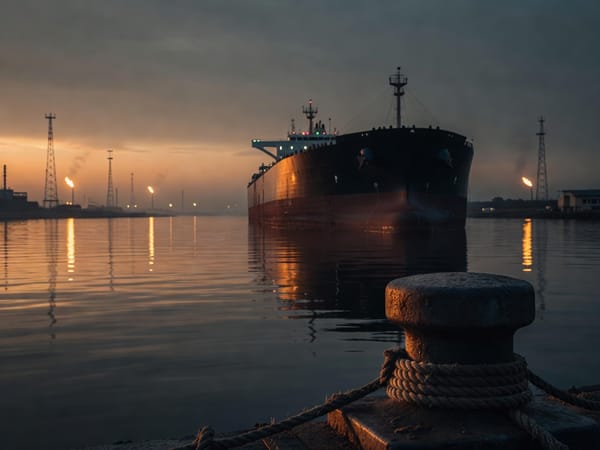
The United States spent the week tightening the economic squeeze on Iran while scouring the world for the diesel its own blockade helped take off the market.
Secretary of State Marco Rubio said on October 19 that the US military had destroyed Iran's navy, its air force, and the factories producing its missiles and drones. He described this as achieving President Trump's objective of stopping Iran from building a nuclear weapon behind a conventional missile shield. Those are the administration's characterizations of its own campaign.
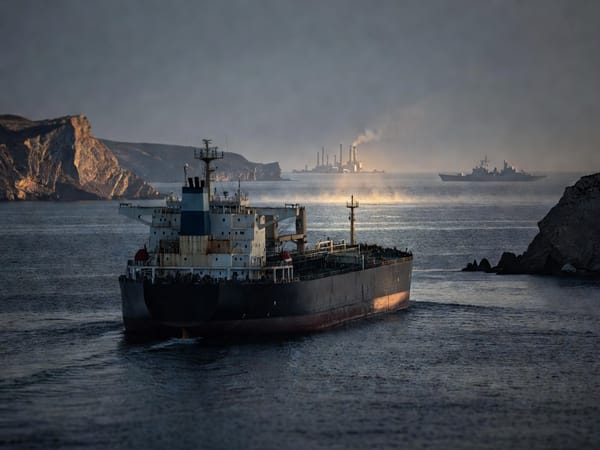
The blockade itself is not new. US Central Command stated in late August that Iran had exported no oil since the blockade resumed in July, that Iranian mines had been cleared from shipping lanes, and that nearly 1,500 commercial vessels had transited under US protection. What moved this week was the enforcement machinery around it. Rubio said further sanctions were imposed, that Treasury Secretary Scott Bessent is leading that effort, and that the US Navy defends commercial shipping against Iranian strikes nightly.
The two available measurements of the waterway do not sit easily together. Rubio put current flows at about 13 to 14 million barrels a day. The International Energy Agency measured 7.6 million barrels a day in August, roughly 13.1 million below pre-war levels, with cumulative losses through the strait approaching 2.8 billion barrels.
On October 21 the Treasury Department's Office of Foreign Assets Control sanctioned a Panama- and Greece-based law firm, Karnakis and Karnakis, its principals, a Singapore company, a Dubai shipping line, a maritime trading firm, and seven Panama-flagged cargo vessels. The action came under Operation Economic Outcast, the campaign Bessent launched in late August, and follows packages on October 1 against Iran's automotive and rail sectors and on October 8 against shadow fleet operators, aging ships that hide their identities to move sanctioned cargo.
The bill lands well outside Iran. European Commission President Ursula von der Leyen told the UN in September that imported fossil fuels had cost the EU an extra 90 billion euros since the strait shut. Diesel sets the cost of freight and winter heating, which is how a Gulf blockade reaches European and Indian invoices.
Three Pieces of Russian Sanctions Relief in Two Days
Inside forty-eight hours the administration handed Russia and its oil customers three separate forms of sanctions relief, each justified by fuel supply or peace talks rather than by any shift in Russian conduct.
On October 19 Trump ordered a 30-day moratorium on sanctions to let more Russian diesel reach the global market. Rubio said the decision was made because the US economy needs a larger diesel supply, not because it is good for Russia or bad for Ukraine.
The same day, Rubio said the president had suspended sanctions for 60 days to see whether talks with Ukraine and Russia could produce a positive outcome and avoid another year of war. He did not specify which sanctions were suspended.
A day later came a third measure. Rubio said Trump used a national security waiver to avoid immediately implementing the tariffs and sanctions in the latest congressional bill targeting countries still doing business with Russia. The practical effect was to let India keep buying Russian crude without triggering the tariffs the law requires. Rubio said the president judged those tariffs would have a very detrimental impact on the relationship with India, and acknowledged the decision drew domestic criticism. Speaking in Mumbai on October 22, he called the package a short-term balancing measure amid high diesel prices and disruptions in the Strait of Hormuz and the Red Sea.
The diplomatic track moved alongside it. Rubio confirmed on October 21 that US envoy Steve Witkoff had met Ukrainian President Volodymyr Zelenskyy and was traveling to St Petersburg with updated American ideas for a peace deal. He said the core dispute remains the part of Donbas that Russia demands but has not captured. By October 22, after Putin said he was open to a three-way meeting, Rubio said the war cannot be solved militarily and the United States was willing to mediate.
One piece came from an unusual quarter. On October 23 First Lady Melania Trump announced a localized ceasefire in Oleshky, a front-line city in Kherson, beginning October 29, to allow humanitarian aid and a civilian evacuation through a safe passageway. She said she acted as Exclusive Intermediary. Such local truces have precedent: the International Atomic Energy Agency brokered the seventh of them around the Zaporizhzhya nuclear plant in September to allow power line repairs.
Europe is carrying the financial load. European Council President António Costa said the EU has disbursed nearly 16 billion euros to Ukraine this year under the defense component of its support loan, and that Europe and its member states account for 80 percent of all external aid to Ukraine.
Brussels Builds Its Arctic Policy Around Russia and China, Then Settles With Beijing
The European Commission published an Arctic strategy that puts military security ahead of climate cooperation, then announced trade understandings with China the following day.
The strategy, adopted on October 20 and titled "European Northern Neighbourhood," updates the bloc's 2021 Arctic policy. It cites Russia's expanded military footprint in the High North, China's growing strategic ambitions, and rapid Arctic warming. The measures are concrete: surveillance through the Copernicus and Galileo satellite systems, an Arctic Cable Hub, joint icebreaker procurement, improved military mobility, 260 million euros through the European Defence Fund, and investment in Greenland's energy, raw materials and connectivity. High Representative Kaja Kallas and Commissioner Síkéla presented it. Von der Leyen said it responds to Russia rebuilding its Arctic military presence and pursuing hybrid strategies, and aims to change the EU's strategic posture.
Then came the opposite instrument. On October 21 the EU and China reached understandings under which China agreed to cut tariffs on European products worth almost 4 billion euros, give greater predictability on export controls for rare earths and magnets, remove certain European companies from Chinese control lists, and accept an annual quota of 350,000 hybrid vehicles exported to the EU.
Washington moved the other way in the same week. On October 19 the Office of Foreign Assets Control added five Chinese entities to its Non-SDN Menu-Based Sanctions List under the Protecting American Intellectual Property Act of 2022, among them the MiraclePlus venture capital funds and Shanghai Zhisuan Technology. The designations bar US financial institutions from extending loans above $10 million in any twelve-month period and prohibit US persons from significant equity or debt investment in the named firms.
Alaska Gas, an Iowa Reactor and a Decade of F-35s Get Locked In
Several of the week's agreements commit capacity a decade or more into the future, which matters more than their headline values.
On October 22 Trump issued a determination under Section 303 of the Defense Production Act of 1950 finding that domestic petroleum production, refining and logistics capacity, including pipelines, storage and marine terminals, are essential to the national defense. Refining is now formally military infrastructure.
The same day the Department of Energy announced a loan of up to $1.9 billion to NextEra to restart the Duane Arnold Energy Center, Iowa's only nuclear plant, returning 615 megawatts of baseload power, enough for nearly 500,000 homes. The Department of War also finalized a ten-year F-35 framework with Lockheed Martin guaranteeing a floor of 850 US aircraft, subject to congressional appropriations, three days after signing a seven-year framework with BAE Systems for up to 25,000 Advanced Precision Kill Weapon System guidance sections a year to build counter-drone interceptor stocks.
The White House closed the week with an energy package. It announced a $54 billion agreement with South Korea and Taiwan to build the long-stalled Alaska natural gas pipeline, which the release says will cut Alaskans' energy costs by $10 billion, alongside South Korean investment in a Texas gas facility. The same release said agreements had been reached with numerous unnamed countries to release more than 130 million barrels of diesel from their stockpiles.
The release also restated the Venezuela oil agreement as the largest in world history, securing 65 billion barrels. That deal is not new. Rubio and Secretary of War Pete Hegseth signed it in late August, granting hundred-year concessions on 17 fields, and the White House has re-announced it repeatedly since. New this week is only the claim that Venezuelan oil imports have risen sharply since it was signed.
What It Means
Sanctions are being run as inventory management. A blockade held firmly against one producer, three relief measures granted to another inside two days, and a coordinated release of 130 million barrels from national stockpiles are one policy, not three. The lever opens and closes according to what refineries need this month, and the stated reasons confirm it: Rubio justified Russian relief by American diesel demand, not by anything Russia did.
The cost of a supply-side pressure campaign falls on the people running it. Removing a producer's barrels creates a shortage someone must fill, and this week that meant favors to Russia, a waiver for India, a re-advertised Venezuelan concession and a request that allies open their reserves. Europe's extra 90 billion euro fuel bill is the Iran campaign appearing on someone else's balance sheet.
Governments are buying certainty at a premium because they no longer expect supply to be reliable. A ten-year aircraft floor, a seven-year munitions line, a loan to restart a retired reactor, a trans-Pacific pipeline contract and a legal finding that refineries are defense assets share one assumption: markets will not deliver these on demand. Long contracts are what replaces a working spot market.
Washington and Brussels are treating the same dependency on China with opposite tools. Within three days, Brussels traded tariff relief for predictability on rare earth export controls while Washington blacklisted five Chinese firms from US investment. The Arctic strategy points the same way: Europe is building its own surveillance, icebreakers and defense funding rather than assuming someone else will.
What to Watch Next Week
The 30-Day Diesel Window Starts Closing: The Russian diesel moratorium was ordered on October 19 and runs about a month; the separate 60-day talks suspension runs into December. Watch for a formal Treasury license or extension, reported Russian diesel volumes into Europe and Asia, and any congressional response to the waiver that bypassed its own Russia bill.
The Oleshky Ceasefire Holds or Collapses: The Kherson truce is set to begin October 29. Watch for confirmation that the evacuation corridor opened, violation claims from either side, and whether Witkoff's St Petersburg track yields a date for the three-way meeting Putin said he would accept.
The Next Operation Economic Outcast Package: These packages have landed every one to two weeks since late August. Watch for designations naming vessels or traders in Greece, Panama, Singapore or the UAE, the first designation of a buyer of Iranian oil rather than a shipper, and whether the Qatari and Pakistani mediation Rubio welcomed produces a meeting.
Generated from structured event data extracted from official government and institutional sources. Not financial or legal advice.