Soil Secrets
Discover how billions of soil organisms power your food, how composting turns waste into a living soil upgrade, and simple gardening practices that build resilience from the ground up.


Beneath every park bench, garden bed, and cracked city sidewalk lies a world most of us never think about. Soil isn't an inert layer of brown stuff — it's one of the most biologically dense ecosystems on Earth, responsible for growing roughly 95% of the food we eat, filtering our drinking water, and storing vast quantities of carbon. Understanding how this underground system works — and how to support it — is one of the most practical things you can do for your own food resilience and the planet's long-term health.
Billions of Workers You've Never Met
A single teaspoon of healthy soil can contain more microorganisms than there are humans on Earth. Bacteria, fungi, protozoa, nematodes, and earthworms form an intricate food web that breaks down organic matter, cycles nutrients, and builds the crumbly, moisture-retaining structure that plants depend on.
Fungi deserve special attention here. Mycorrhizal networks — sometimes called the "wood wide web" — form symbiotic partnerships with plant roots, extending their reach by up to a hundred times. In exchange for sugars from the plant, these fungal threads deliver phosphorus, zinc, and water from soil pockets that roots alone could never access. Research published in Nature Geoscience in 2025 reinforced that long-term nutrient management can increase soil organic carbon by 22–28%, largely because it sustains these microbial communities.
Earthworms, meanwhile, act as biological tillers. Their tunnels aerate compacted ground and their castings are among the richest natural fertilisers available. When this underground workforce is healthy, the soil above it almost takes care of itself.
Why This Matters More Than You Think
The United Nations estimates that roughly 33% of the world's soils are moderately to highly degraded — a figure driven by industrial monoculture, deforestation, and urban sprawl. At the current rate, the equivalent of four football fields of productive soil is lost every single second to erosion and nutrient depletion.
Degraded soil doesn't just mean lower crop yields. It means weaker nutritional profiles in the food that does grow, reduced water filtration, and the release of stored carbon back into the atmosphere. For anyone interested in food security — personal or global — soil health is the foundation everything else rests on.
The encouraging part: soil is remarkably responsive to better management. Even heavily depleted land can begin recovering within a few growing seasons when treated with the right practices.
Composting: Your Kitchen's Best Kept Secret
Composting is the simplest entry point into soil stewardship. It converts food scraps and yard waste into a dark, crumbly amendment that feeds the microbial communities your soil depends on — and it keeps organic waste out of landfills, where it would decompose anaerobically and release methane, a greenhouse gas roughly 27–30 times more potent than carbon dioxide over a 100-year period (per the IPCC's Sixth Assessment Report).
Getting the Balance Right
Effective composting relies on a rough carbon-to-nitrogen ratio of about 25–30:1. In practice, that means layering "browns" (dried leaves, shredded cardboard, wood chips) with "greens" (vegetable peelings, coffee grounds, fresh grass clippings). Adequate moisture — damp like a wrung-out sponge — and occasional turning for airflow keep aerobic microbes active and prevent foul odours.
A well-managed backyard bin can produce usable compost in two to four months. Apartment dwellers can use a countertop bokashi system or a worm bin (vermicomposting), both of which work in surprisingly small spaces. Many cities also run community compost drop-off programmes worth looking into.
What Compost Actually Does
When you work finished compost into soil, you're not just adding nutrients. You're improving the soil's physical structure — its ability to hold water without becoming waterlogged, resist compaction, and support root growth. You're also inoculating it with beneficial microbes that suppress plant diseases and make nutrients more bioavailable. Think of compost less as fertiliser and more as a living soil upgrade.
Gardening With the Ecosystem, Not Against It
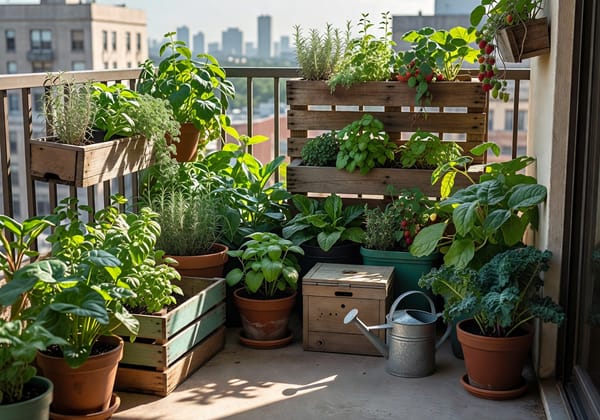
Whether you have a half-acre plot or a few balcony containers, a handful of mindful practices can dramatically improve the ground you're working with.
Minimise disturbance. Every time you dig or till, you break apart fungal networks and expose soil carbon to the air. No-dig or no-till methods — where you add compost and mulch on top rather than mixing them in — preserve soil structure and let biology do the heavy lifting.
Plant cover crops. Bare soil erodes, dries out, and loses nutrients. Cover crops like crimson clover, winter rye, or buckwheat protect the surface, suppress weeds, and — in the case of legumes — fix atmospheric nitrogen directly into the root zone. When these plants are cut and left to decompose in place, they become a free source of organic matter.
Rotate and diversify. Growing the same crop in the same spot season after season depletes specific nutrients and invites pest buildup. Rotating plant families and interplanting with flowers or herbs creates a more resilient, biologically diverse soil community.
Avoid synthetic shortcuts. Concentrated synthetic fertilisers deliver a quick nutrient hit but can acidify soil and suppress microbial life over time. Synthetic pesticides often kill beneficial insects alongside the pests. Compost, mulch, companion planting, and biological controls (like encouraging ladybirds or using neem oil) address the same goals without the collateral damage.
Soil as Climate Infrastructure
Soil is the planet's second-largest carbon reservoir after the oceans. Practices that build soil organic matter — composting, cover cropping, reduced tillage, agroforestry — actively pull CO₂ from the atmosphere and lock it into stable carbon compounds underground. A 2025 review in Springer Nature highlighted that combining these regenerative strategies can measurably increase soil carbon stocks within just a few years.
This isn't abstract climate policy — it's something any gardener or smallholder can contribute to. Every handful of compost worked into a bed, every patch of bare earth covered with a living crop, adds incrementally to the soil's capacity to store carbon, hold water, and support life.
Where to Start
You don't need acreage to make a difference. Start a small compost bin with kitchen scraps. Mulch around your plants instead of leaving soil exposed. Try one cover crop this season. Skip the synthetic weed killer and pull by hand or smother with cardboard and mulch. Each of these actions feeds the underground ecosystem that, in turn, feeds you.
Soil responds to care faster than most people expect. Give it a season of better treatment and you'll see the difference in darker colour, better moisture retention, and healthier plants. The secrets aren't really secrets at all — they're just practices we stopped paying attention to.