Understanding Peak Oil and Energy Transition
Peak oil isn't just about running out - it's about the rising cost of every barrel. Here's what the energy transition means for your life and choices.


The Question That Shapes the Century
Every modern economy runs on energy. The food on your table, the device you are reading this on, the transport that brought both to you - all of it depends on a vast, mostly invisible energy system. And at the heart of that system, for over a century, has been oil.
But oil is a finite resource extracted from underground reservoirs that took millions of years to form. The question is not whether these reserves will eventually become harder to access - it is when, how fast, and what we do about it. That question is what peak oil is really about, and understanding it gives you a clearer picture of the economic and environmental forces shaping the next few decades.
What Peak Oil Actually Means
Peak oil is often misunderstood as running out of oil. It is not. The concept, first modelled by geologist M. King Hubbert in 1956, describes the point at which global oil extraction reaches its maximum rate - after which production enters a permanent decline, regardless of how much oil remains underground.
The distinction matters. There is still plenty of oil in the ground. The problem is that the easy, cheap-to-extract oil was tapped first. What remains is increasingly difficult, expensive, and energy-intensive to reach - deep offshore fields, oil sands, tight shale formations, and Arctic deposits.
As of 2024, the International Energy Agency forecasts that peak oil demand could arrive by 2030. Other agencies see different timelines - the US Energy Information Administration projects a peak closer to 2050, while OPEC does not foresee a demand peak before 2045. What is notable is that the debate has shifted from will we run out to will demand decline before supply does.
The answer to that question will be shaped by how quickly the world transitions away from oil-dependent systems - particularly in transport, which accounts for roughly half of all oil consumption in developed countries.
The Hidden Variable: Energy Return on Investment
Here is where the conversation gets more interesting and more practical. Beyond the raw number of barrels produced, what matters is the net energy those barrels deliver.
Energy Return on Investment (EROI) measures how much usable energy you get back for every unit of energy you spend extracting it. In the 1930s, conventional oil had an EROI of roughly 100:1 - for every barrel's worth of energy invested, you got a hundred back. That was an extraordinary energy surplus, and it powered the explosive economic growth of the 20th century.
Today, the global average EROI for oil has dropped considerably. Conventional onshore and shallow offshore fields still deliver EROIs around 20-30:1, but these mature fields are depleting. Newer sources tell a different story: deepwater offshore oil comes in around 10-12:1, oil sands around 3-5:1, and oil shale hovers near 1.5:1.
Research published in the Journal of Petroleum Technology found that while gross oil production may not peak until the mid-2030s, net energy from oil - the energy actually available to society after extraction costs - may have already peaked or is peaking right around now. The energy needed for oil extraction is growing exponentially, representing roughly 15% of oil's total energy output today and projected to keep climbing.
This matters more than production statistics alone. A society that produces 100 million barrels per day but spends 25 million barrels worth of energy extracting them is in a fundamentally different position than one producing 80 million barrels at a cost of 5. The net energy available to run everything else - industry, transport, food systems, heating - is what actually drives economic activity.
What Is Replacing Oil?
The energy transition is not a single event - it is a complex, decades-long shift that is already underway. Several forces are driving it.
Electrification of Transport
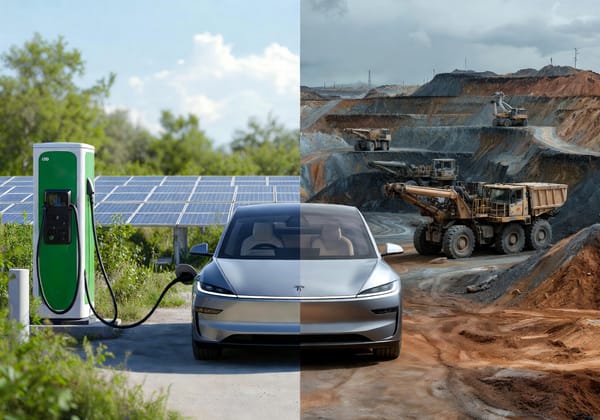
Electric vehicles are the most visible part of the transition. They directly reduce oil demand by replacing internal combustion engines. However, as existing LifeSufficient coverage of EVs has explored, the environmental picture is more nuanced than it appears. EV batteries require lithium, cobalt, and nickel - all of which carry their own extraction costs. And the electricity powering those vehicles still comes predominantly from fossil fuels in many countries. Globally, about 60% of electricity generation relies on coal, oil, or natural gas.
The regions doing best include Iceland (100% renewable electricity), Norway (98% hydroelectric), and France (70% nuclear with 20% renewable). But much of Asia and Africa - where energy demand is growing fastest - still runs heavily on fossil fuels.
Renewable Energy Growth
Solar and wind capacity have grown dramatically over the past decade, and costs have fallen to the point where new renewables are often cheaper than new fossil fuel plants. Wind turbines typically deliver EROIs between 16 and 20 unbuffered, and solar photovoltaic panels range from about 8 to 34 depending on location and technology.
Interestingly, recent research published in Nature Energy found that when you measure EROI at the useful energy stage - the energy that actually does work in your home or factory, rather than the raw fuel - renewables like wind and solar already outperform fossil fuels. Fossil fuels useful-stage EROI comes in around 3.5:1, because so much energy is lost as waste heat in combustion engines and power plants. Electricity from renewables, by contrast, converts more efficiently into useful work.
This does not mean the transition is simple. Wind and solar are intermittent - they produce energy when conditions are right, not necessarily when you need it. Bridging that gap requires energy storage (primarily batteries), grid upgrades, and backup capacity, all of which have their own energy and material costs.
Nuclear Power
Nuclear energy remains one of the highest-EROI sources available, with estimates ranging from 56 to over 100:1 depending on the study and reactor type. It provides reliable baseload power without carbon emissions during operation. Countries like France have demonstrated that nuclear can serve as the backbone of a low-carbon grid.
The challenges are well known: high upfront capital costs, long construction timelines, waste storage requirements, and public safety concerns. But next-generation reactor designs - smaller, modular, and inherently safer - are attracting renewed investment from both governments and private companies.
The Geopolitical Dimension
Energy transitions do not happen in a vacuum. Oil has been the backbone of geopolitical power for a century. Control over oil reserves and shipping routes - like the Strait of Hormuz, through which nearly 20% of global oil supply passes - has shaped alliances, triggered conflicts, and defined the foreign policies of major powers.
As the world shifts toward renewable energy, oil-dependent economies face an existential challenge. Saudi Arabia's Vision 2030 programme is perhaps the most prominent attempt to diversify away from oil dependence, but the transition is fraught with economic and political risk. Meanwhile, the US and EU are diverging on climate regulation - Europe has adopted binding 2040 climate targets, while US policy has shifted toward expanded fossil fuel production and deregulation.
For individuals, the practical implication is that energy prices and availability will remain volatile for years, possibly decades, during this transition. Supply disruptions, geopolitical crises, and policy shifts can all create sudden price spikes that ripple through food costs, transport, and heating bills.
What This Means for You
Understanding peak oil and the energy transition is not about predicting doomsday scenarios. It is about seeing the forces that will shape energy prices, economic growth, and environmental conditions during your lifetime - and making informed choices in response.
Here are practical steps worth considering:
Reduce your energy dependence. Simple measures - better home insulation, efficient appliances, reducing unnecessary travel - lower your exposure to energy price volatility. They also save money regardless of what happens in global energy markets.
Understand your energy sources. Find out how your region generates electricity. If your grid is heavily fossil-fuel dependent, the green benefits of electric vehicles or heat pumps are reduced. If your grid is cleaner, electrifying your home energy use becomes a genuinely effective strategy.
Build energy literacy. When politicians, companies, or media commentators make claims about energy, you will be better equipped to evaluate them if you understand concepts like EROI, grid mix, and the difference between gross and net energy. Much energy debate is driven by ideology rather than thermodynamics.
Think in systems. Energy connects to food, transport, manufacturing, and geopolitics. A disruption in oil supply does not just raise petrol prices - it raises the cost of fertiliser, shipping, plastics, and pharmaceuticals. Building resilience means thinking about these connections and having backup options where possible.
Stay informed without panicking. The energy transition is happening, but it is a multi-decade process with enormous uncertainty about pace and pathway. Neither cornucopian optimism nor catastrophic pessimism reflects reality. The truth is messier and more interesting than either extreme.
The Road Ahead
The age of cheap, abundant oil is winding down - not because the wells are suddenly empty, but because the energetic and economic cost of extraction keeps rising while alternatives keep improving. This is a structural shift, not a crisis to panic about.
The societies and individuals who navigate this transition best will be those who understand what is happening, reduce unnecessary energy dependence, and invest in resilience. The energy system that emerges on the other side will look very different from today's - likely more electrified, more distributed, and more diverse in its sources.
Your role in this is not passive. Every choice about how you heat your home, how you travel, what you buy, and how you vote contributes to the speed and shape of this transition. Understanding the fundamentals - peak oil, EROI, grid mix, geopolitical stakes - puts you in a stronger position to make those choices wisely.