Global Brief: Apr 20 – Apr 26
The Strait of Hormuz closed. Washington invoked wartime production powers. Brussels finalized €90B for Ukraine. One week, three permanent shifts.


The week in brief. The effective closure of the Strait of Hormuz triggered the largest oil supply disruption in modern history, and both Washington and Brussels responded with structural measures rather than stopgaps. The European Union finalized a €90 billion loan to Ukraine while adopting its 20th sanctions package against Russia, targeting shadow fleets, banks, and crypto networks. The White House released a $1.5 trillion defense budget and invoked wartime production authorities across the entire fossil fuel supply chain. Across all three stories, governments are building permanent institutional architecture around what they now treat as permanent threats.
The Week in Detail
Hormuz Closure Forces Washington and Brussels into Emergency Energy Mobilization
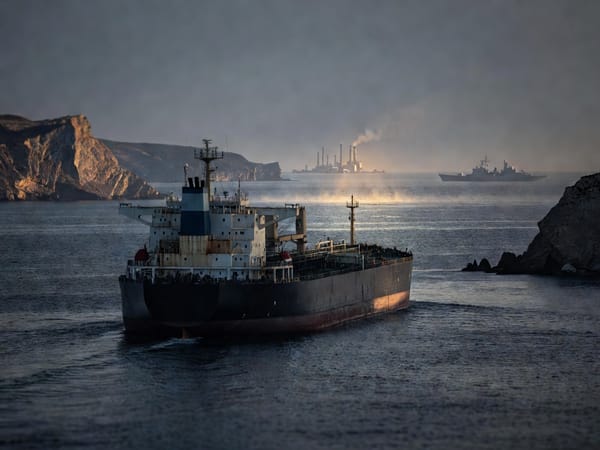
Conflict in the Middle East effectively shut down the Strait of Hormuz this week, cutting off the world's most important oil chokepoint and triggering what the International Energy Agency (IEA) called the largest supply disruption in oil market history. Natural gas and energy-related commodities followed crude prices upward, and the pressure reached households and economies within days.
The response was immediate and coordinated across two continents. IEA member countries carried out the largest-ever release of emergency oil stocks. In Washington, President Trump signed four Presidential Determinations on April 20 invoking Section 303 of the Defense Production Act (DPA) of 1950, a wartime authority that allows the federal government to purchase, finance, and subsidize industrial capacity it deems essential to national defense. The four determinations covered petroleum production and refining, coal supply chains and baseload power generation, natural gas infrastructure including liquefied natural gas (LNG) export facilities, and large-scale energy infrastructure broadly. Each directed the Secretary of Energy to begin implementing purchases and financial support.
With the National Energy Emergency declared earlier this year already in effect under Executive Order 14156, these DPA invocations gave the administration legal tools to bypass normal permitting and financing constraints. The practical effect: the federal government can now act as a buyer, lender, or guarantor across the full fossil fuel supply chain.
The European Commission moved in parallel. On April 22, it published AccelerateEU, a strategy of short-term and structural measures responding to the Middle East conflict's impact on European energy markets. Two days later, EU leaders meeting in Lefkosia welcomed the prolongation of the US-Iran ceasefire and the Lebanon-Israel ceasefire. European Commission President Ursula von der Leyen outlined conditions for lasting peace, including full navigation freedom through the Strait of Hormuz without tolls and resolution of Iran's nuclear and ballistic missile programs.
On the enforcement side, the US Treasury's Office of Foreign Assets Control (OFAC) on April 24 sanctioned Hengli Petrochemical (Dalian) Refinery Co., Ltd., one of Iran's largest crude oil customers, along with approximately 40 shipping firms and vessels operating in Iran's shadow fleet, a network of older tankers that disable tracking systems to move sanctioned oil. The action, part of the "Economic Fury" campaign, targeted billions of dollars in Iranian petroleum flowing to markets in China, the United Arab Emirates (UAE), and elsewhere. This was the latest in a series of OFAC actions against Iran's shadow fleet dating back to January, when Treasury designated eight companies and nine vessels for the same purpose.
EU Finalizes €90 Billion Ukraine Loan and Adopts 20th Sanctions Package Against Russia
The EU completed two of its largest wartime financial commitments in a single day. On April 23, the EU Council finalized a €90 billion support loan to Ukraine, the culmination of a process that began with the European Council's December 2025 decision and was fast-tracked through the European Parliament in January. The first tranche of €45 billion is expected this quarter, with one-third allocated to budgetary needs and two-thirds to defense, starting with a drones package produced in Ukraine.
The loan is financed by EU borrowing backed by budget headroom and is structured to be repayable through future Russian reparations. Twenty-four member states participate under an enhanced cooperation framework; Czechia, Hungary, and Slovakia opted out. The trilateral meeting in Lefkosia between Presidents António Costa, von der Leyen, and Volodymyr Zelenskyy served as the political capstone, with all three urging swift disbursement.
On the same day, the EU Council adopted its 20th package of sanctions against Russia. The package targeted Russia's energy revenues by listing 46 shadow fleet vessels and banning them from EU ports, including access to the Russian ports of Murmansk and Tuapse and the Indonesian port of Karimun. It introduced a basis for a full maritime services ban on Russian oil transport, including shipping, financing, and insurance, coordinated with the G7 and Price Cap Coalition.
Beyond energy, the package banned transactions with 20 additional Russian banks and four banks in the Kyrgyz Republic, Lao PDR, and Azerbaijan. For the first time, the EU imposed a sectoral ban on Russian crypto-asset providers and decentralized platforms, and it banned the RUBx stablecoin and the Digital Rouble. The package designated 58 entities in Russia's military-industrial complex, including drone manufacturers, and 16 third-country suppliers in China, the UAE, Uzbekistan, Kazakhstan, and Belarus. In another first, the EU activated its anti-circumvention tool against the Kyrgyz Republic, banning exports of machine tools and telecommunications equipment.
The 120 new individual listings brought total EU sanctions on Russia-linked persons and entities to their highest level since the war began.
$1.5 Trillion Defense Budget and a Transatlantic Critical Minerals Pact
The Department of War (DoW) released President Trump's Fiscal Year 2027 defense budget on April 21, requesting $1.5 trillion, a 42% increase over current levels. According to the DoW release, $756.8 billion would go toward new capabilities intended to rebuild the Defense Industrial Base and create hundreds of thousands of manufacturing jobs. Major line items included $74 billion for drones, $65.8 billion for shipbuilding under the Golden Fleet program with 18 new vessels, $75 billion for the United States Space Force, over $20 billion for cyber capabilities, $18 billion for the Golden Dome missile defense system, and a $31.7 billion increase in core readiness funding. The budget proposed cutting $20 billion in what it called unnecessary spending while adding 44,000 service members.
Three days later, in Washington, EU Commissioner for Trade and Economic Security Maros Sefcovic and US Secretary of State Marco Rubio signed a Memorandum of Understanding (MoU) formalizing a strategic partnership on critical minerals supply chains. Sefcovic and US Trade Representative Jamieson Greer simultaneously published an EU-US Critical Minerals Action Plan covering trade policies, standards, investment, research, stockpiling, and coordinated responses to supply disruptions. The deal reflects both sides' concern over Chinese dominance in rare earth processing, a vulnerability that became more acute as China expanded its export controls on these materials for the third time this year.
What It Means
The week's defining pattern was the conversion of crisis responses into lasting institutional commitments. The Hormuz closure, Russia's ongoing war in Ukraine, and strategic competition with China each prompted actions designed to outlast the immediate emergency. DPA determinations, unlike executive orders, authorize open-ended purchasing authority. The EU's €90 billion loan is structured over two years. The critical minerals MoU creates a permanent coordination mechanism. These are not patches.
The convergence of US and EU sanctions against shadow fleets is particularly notable. Washington's "Economic Fury" campaign against Iran's oil network and Brussels' 20th sanctions package against Russia's shadow fleet used nearly identical tools: vessel listings, port bans, financial network disruptions, and targeting of third-country facilitators. The two campaigns remain legally separate, but operationally they are compressing the space available to any country trying to move oil outside Western-supervised channels.
Energy is now treated as defense infrastructure on both sides of the Atlantic, and the policy tools reflect that. The US invoked wartime production authorities for petroleum and coal. The EU allocated two-thirds of its Ukraine loan to defense and embedded energy measures in its sanctions architecture. The critical minerals MoU extends this logic to the inputs that military and energy systems both depend on.
What to Watch Next Week
Hormuz Ceasefire Durability: The prolonged US-Iran ceasefire and Lebanon-Israel ceasefire are holding, but conditions for permanent resolution remain unmet. Watch for statements from Tehran on navigation tolls, any IRGC naval activity in the strait, and whether IEA members announce additional stock releases or signal that the first release was sufficient.
EU Ukraine Loan Disbursement: With the €45 billion first tranche authorized for Q2, the first actual transfer could come within days. Watch for European Commission disbursement announcements, Ukrainian procurement orders for the drones package, and any statements from Hungary or Slovakia challenging the enhanced cooperation framework.
Defense Budget Congressional Reception: The $1.5 trillion request faces Congressional review. Watch for Armed Services Committee hearing schedules, early statements from fiscal hawks on the 42% increase, and whether defense contractors announce capacity expansions or hiring tied to Golden Dome, Golden Fleet, or drone program funding.
Generated from structured event data extracted from official government and institutional sources. Not financial or legal advice.