Generosity in Communities
How generosity builds trust, triggers neurochemical rewards, and creates resilient communities — with practical strategies to cultivate a culture of giving.


Every strong community you've ever encountered — a neighborhood that rallies after a storm, a workplace where people genuinely help each other, an online group that actually solves problems — shares one trait that's easy to overlook. It isn't shared geography or common interests. It's generosity: the habit of giving time, knowledge, or resources without keeping score.
This isn't a feel-good platitude. Research from the University of Notre Dame's Science of Generosity initiative and studies published in journals like Nature Human Behaviour consistently show that prosocial behavior — voluntary actions intended to benefit others — strengthens social bonds, improves mental health, and makes communities more resilient to crisis. Understanding how generosity works, and how to cultivate it deliberately, is one of the most practical skills you can develop for building a life of genuine self-sufficiency within a connected community.
Trust Is Built Through Small, Repeated Acts
Trust doesn't arrive through grand declarations. It accumulates through small, repeated demonstrations that someone cares about more than their own interests.
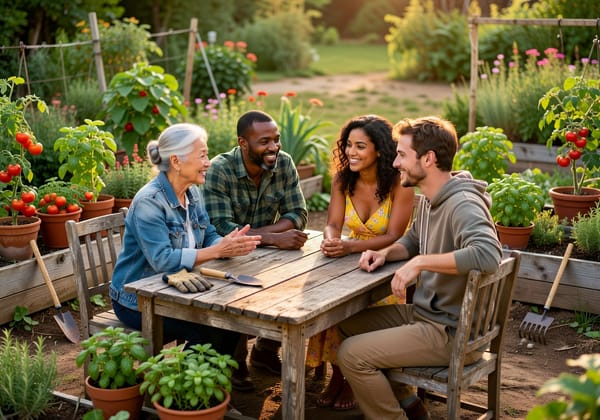
Consider how this plays out in a community garden. One person shares surplus seedlings. A neighbor responds by lending composting equipment. Someone else offers to teach pruning techniques they learned from their grandmother. Within a season, the garden transforms from individual plots into a cooperative ecosystem where people rely on each other — not out of obligation, but because reciprocity became the default.
The same pattern shows up in digital communities. In open-source software projects, developers who share code freely and mentor newcomers establish a culture of openness that compounds over time. When people see that contributions aren't met with gatekeeping or exploitation, they contribute more freely themselves. The result is a self-reinforcing cycle where the community's collective output far exceeds what any individual could produce alone.
This matters because skepticism is the default in most group settings. People reasonably worry about hidden agendas or being taken advantage of. Generosity, practiced consistently and visibly, is the most effective antidote to that skepticism. It proves through action — not words — that the group operates in good faith.
The Ripple Effect Is Real, Not Just Metaphorical
One of the most well-documented findings in prosocial behavior research is that generosity is contagious. When someone witnesses an act of giving, they become measurably more likely to give themselves. This isn't wishful thinking — it's a pattern observed across workplace teams, volunteer organizations, and even anonymous online interactions.
In a professional setting, this might look like a senior team member spending an hour walking a junior colleague through a difficult analysis. That act sets a precedent. Other team members notice, and the informal norm shifts: sharing expertise becomes expected rather than exceptional. Over weeks and months, the team's collective problem-solving capacity grows because knowledge flows freely instead of being hoarded.
The ripple effect becomes especially visible during crises. Research on mutual aid networks, particularly studies examining community responses during the COVID-19 pandemic, found that neighborhoods with pre-existing habits of mutual support organized relief efforts faster, distributed resources more equitably, and maintained social cohesion under extreme stress. Communities where people already knew and helped each other didn't need to build trust from scratch — they simply activated the networks that generosity had already created.
This resilience advantage is significant. A 2025 study published in Humanities and Social Sciences Communications found that community mutual aid networks not only reduce household financial vulnerability during disruptions but also strengthen long-term resilience to future risks. In other words, generosity isn't just a nice-to-have during good times — it's infrastructure for surviving bad ones.
Your Brain Is Wired to Reward Giving
If generosity were purely sacrificial, it wouldn't persist across cultures and centuries the way it does. The reason it endures is partly neurochemical: your brain rewards you for helping others.
Research from institutions including Cedars-Sinai and Heinrich Heine University Düsseldorf has mapped the specific mechanisms involved. Acts of giving trigger the release of oxytocin, dopamine, and endorphins — the same neurochemicals associated with bonding, pleasure, and pain relief. This cocktail produces what researchers call the "helper's high," a measurable boost in mood and well-being that follows selfless action.
The effects go deeper than a momentary mood lift. A 2025 study identified the basolateral amygdala as a key brain region that calibrates prosocial behavior, suggesting that generosity is regulated by some of the same neural architecture that manages our fundamental social responses. Studies on oxytocin have found that participants given oxytocin were up to 80% more generous than those given a placebo, highlighting how deeply intertwined our neurochemistry is with our prosocial impulses.
Practically, this means generosity creates a positive feedback loop. You give, your brain rewards you, you feel more connected to your community, and that connection motivates more giving. Understanding this cycle is useful because it reframes generosity not as self-sacrifice but as a mutually beneficial investment — one where the returns compound over time.
Overcoming the Reluctance to Give
Knowing that generosity is beneficial doesn't automatically make it easy. Several common barriers get in the way, and recognizing them is the first step to working through them.
The most common barrier is scarcity thinking — the fear that giving away time, knowledge, or resources leaves you with less. This fear is understandable but usually misplaced. In professional networks, for example, people who share expertise freely tend to build reputations that attract opportunities, mentorship, and alliances. The perceived loss is almost always smaller than the long-term gain.
Another barrier is uncertainty about motives. Some people hesitate because they worry their generosity will be seen as performative or manipulative. Here's a useful reframe: the impact of a generous act doesn't depend on having perfectly pure motivations. Whether you volunteer because it makes you feel good, because it builds your network, or because you genuinely want to help, the community benefits just the same. Waiting for flawless altruism before acting means never acting at all.
Finally, people often don't give simply because they don't know how. They see a need but feel unsure what they could contribute. This is a design problem, not a character flaw — and it has practical solutions.
Building a Culture of Generosity in Practice
If you want generosity to become the norm in your community rather than an occasional exception, it helps to think about it structurally. Three approaches consistently work across different types of communities.
Start With Visible, Low-Stakes Actions
The most effective way to seed a giving culture is to model it yourself, starting small. In a book club, this might mean researching discussion questions before each meeting. In a neighborhood, it could be as simple as leaving surplus produce from your garden on a shared table. In a workplace, it might be sending a colleague an article relevant to their project without being asked.
These acts work not because they're individually transformative, but because they're visible. They signal what's valued in the group and give others implicit permission to do the same.
Recognize Contributions, Even Small Ones
Recognition is one of the most powerful and underused tools for reinforcing generosity. A specific thank-you in a group chat, a shout-out during a meeting, or a brief message acknowledging someone's contribution costs nothing and accomplishes a lot. It tells the giver their effort was noticed, and it tells everyone else that giving is valued here.
The key is specificity. "Thanks for helping out" is fine. "Thanks for staying late to help debug the deployment issue — that saved the whole team a stressful morning" is much better. Specific recognition makes people feel genuinely seen rather than generically appreciated.
Create Structures That Make Giving Easy
People are far more likely to give when the path is clear and friction is low. A neighborhood tool-lending library, a skills-exchange board at a community center, a mentorship matching program at work — these structures convert latent goodwill into actual action.
One particularly effective format is the skill swap: a regular event where community members teach each other something they know. One person demonstrates basic bicycle repair, another walks through how to read a lease agreement, someone else shares their approach to meal prepping on a budget. These events create value for participants, but they also build the social connections that make a community resilient.
When Generosity Gets Complicated
A clear-eyed approach to community generosity means acknowledging its limits and failure modes.
Burnout is the most common pitfall. In many groups, a small number of people do the majority of the giving while others free-ride. Over time, this imbalance exhausts the givers and breeds resentment. The solution is distributing the load: celebrate small contributions as enthusiastically as large ones, actively invite quieter members to participate, and normalize setting boundaries. A community that burns out its most generous members isn't sustainable.
Equity also matters. Research on mutual aid during the COVID-19 pandemic highlighted that digital-first mutual aid networks sometimes excluded people without reliable internet access or technical literacy. Effective community generosity requires asking who isn't being reached and adjusting accordingly.
Cultural differences shape how generosity is expressed and received. In more collectivist cultures, giving tends to flow through extended family and community networks as a shared obligation. In more individualist cultures, it's often framed as a personal choice. Neither approach is inherently better, but communities that include people from different cultural backgrounds benefit from being explicit about norms and expectations rather than assuming everyone shares the same framework.
The Practical Case for Giving
Generosity in communities isn't about self-sacrifice or moral superiority. It's a practical strategy for building the kind of social infrastructure that makes everyone — including you — more capable and more resilient.
Here are the key takeaways worth keeping in mind. First, trust is built through consistent small actions, not grand gestures. Second, generosity is neurochemically rewarding — your brain is designed to make giving feel good. Third, the resilience benefits are concrete and well-documented, from faster disaster recovery to reduced financial vulnerability. Fourth, the most common barriers to giving (scarcity thinking, motive anxiety, uncertainty about how to help) all have practical solutions. And fifth, sustainable generosity requires structure, recognition, and attention to equity.
Your next step is simple: identify one thing you can give to your community this week. It doesn't need to be dramatic. Share a useful resource in a group chat. Offer to help a neighbor with a task you're good at. Thank someone publicly for a contribution they made. These small acts are how resilient communities are built — one generous choice at a time.