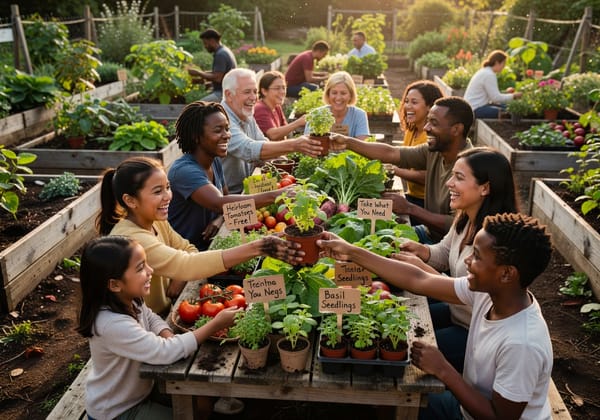
Building a Community from the Ground Up
The strongest communities start with just two or three people and a shared interest. Here's a practical, research-backed guide to building meaningful local connections from scratch.


The Case for Starting Small
Most people picture community building as something that requires a platform launch, a marketing plan, or at minimum a group chat with fifty strangers. That image is backwards. The strongest communities almost always begin with two or three people who share a genuine interest and decide to do something about it together.
There is real science behind why this works. British anthropologist Robin Dunbar's research suggests humans can maintain roughly 150 stable social relationships, with an inner circle of about five. A 2023 study published in Chaos, Solitons & Fractals confirmed that social complexity spikes right around that 150-person threshold — meaning groups that grow beyond it without strong internal bonds tend to fragment. Starting with a handful of people you already trust isn't just easier. It's how durable communities are actually built.
Small groups also carry practical advantages. You can experiment with formats, recover from awkward first meetings, and adjust your approach without high stakes. According to research from the Community Leadership Institute, groups that define a clear mission early — one that blends practical benefits with emotional connection — see 62 percent higher member commitment. That clarity is far easier to establish around a kitchen table than in a crowd.
Take Stock of What You Already Have
Before you create anything new, look at what's already in front of you. Community building starts with three raw materials: people, interests, and spaces.
People You Already Know
Think about the conversations you already enjoy. The colleague who shares your obsession with fermentation. The neighbour who always wants to talk about local politics. The old university friend who texts you links to the same podcasts you listen to. These existing relationships carry trust — the single most important ingredient in early community formation. Data from the 2025 Community Trust Barometer shows that members who feel a community is safe and inclusive are 4.7 times more likely to contribute and 3.2 times more likely to invite others.
You don't need to recruit strangers. You need to activate relationships that already exist.
Interests Worth Organising Around
A community needs a reason to exist beyond socialising. That reason is usually a shared interest specific enough to generate real conversation: urban gardening, open-source software, local history, emergency preparedness, or independent journalism. The more specific the focus, the easier it is to attract people who genuinely care and to create activities that feel worthwhile rather than forced.
The 2026 Community Trends Report found that 67 percent of members say they join or stay in a community because of shared identity or values — not because of perks, content, or platform features.
Spaces That Already Work
Every community needs a place to gather, whether physical or digital. For in-person groups, the best early venues are free or cheap and already familiar: a living room, a park bench, a library meeting room, a regular table at a café. For digital groups, the platform matters less than accessibility. A simple group chat on Signal or WhatsApp is often better than a polished forum that nobody checks. The goal at this stage is reducing friction, not impressing anyone.
Your First Move: Keep It Embarrassingly Simple
The single biggest barrier to community building isn't logistics or technology. It's overthinking the first step. Here's how to get past it.
Send One Message
Pick one person you know who shares an interest. Send them a specific, low-pressure invitation. Not "we should hang out sometime" but something like: "I've been wanting to learn more about local foraging. Want to check out that workshop at the botanical garden on Saturday?" Specificity signals seriousness without pressure.
Host a Gathering of Five
Once you have even one enthusiastic ally, invite three or four more people for a focused, low-effort event. A potluck with a theme. A walk-and-talk. A video call where everyone shares one resource they've found useful recently. Set a clear topic so people know what to expect. The 2025 Community Engagement Index found that members who participate in live events show 340 percent higher retention and 470 percent more peer-to-peer interactions compared to those who only consume content passively.
Five people in a room having a real conversation about something they care about is already a community. Everything that comes after is just growth.
Use Digital Tools as Bridges, Not Destinations
If geography makes in-person gathering difficult, digital tools can fill the gap — but use them intentionally. A neighbourhood post asking a genuine question ("Does anyone know a good source for heirloom seeds locally?") will generate more authentic connection than a generic "join my community" pitch. Platforms like Circle or Mighty Networks offer sophisticated community infrastructure for groups that outgrow simple messaging, but don't jump to them prematurely. Start where your people already are.
Nurture the Early Days
The first few meetings set the culture for everything that follows. Get these fundamentals right and the rest becomes much easier.
Listen More Than You Organise
Ask members what they want from the group. What topics interest them most? What format works for their schedule? What would make them excited to come back? This isn't just politeness — it's practical intelligence. A community shaped by its members' actual needs will always outperform one designed around a single organiser's vision.
Establish a Rhythm You Can Sustain
Consistency matters more than frequency. A monthly meetup that actually happens every month builds more trust than a weekly one that keeps getting cancelled. Pick a cadence you can maintain for six months without burning out, then stick to it. Most successful small communities start with monthly gatherings and increase frequency only when demand clearly justifies it.
Name What's Working
When something goes well — a great discussion, a useful resource someone shared, a new member who fits perfectly — say so out loud. Recognition doesn't need to be elaborate. A quick message in the group chat ("That article you shared last week completely changed how I think about water filtration — thank you") reinforces the behaviours that make communities valuable.
Growing Without Losing What Makes It Work
Growth is not the point of community building, but it often happens naturally when a group is healthy. The challenge is expanding without diluting the qualities that made the group worth joining.
Let Members Bring Members
The best growth strategy is word of mouth from people who are already invested. When someone asks if they can invite a friend, that's a sign your community is working. Organic recruitment through existing members tends to produce better cultural fit than any public marketing effort. A simple guideline — "bring someone you think would genuinely enjoy this" — keeps growth intentional.
Distribute Responsibility Early
The fastest way to kill a community is to make one person responsible for everything. As soon as your group has regular attendees, start sharing ownership. Ask someone to choose the next meeting topic. Let another person handle logistics for an event. Shared responsibility deepens investment and makes the community resilient. Research consistently shows that communities designing for shared ownership see higher long-term engagement.
Protect Your Core Purpose
As a community grows, opportunities and distractions multiply. Someone will suggest a sponsorship. Another person will want to pivot the focus. A platform will offer to "amplify your reach." Before saying yes to anything, ask whether it serves the original reason your group exists. The communities that last are the ones that can say no to things that don't align with their values, even when those things look appealing on the surface.
When Things Get Difficult
Every community hits rough patches. Anticipating them makes them easier to navigate.
Burnout is the most common threat. If running the group starts to feel like a second job, scale back before you quit entirely. Reduce meeting frequency, delegate more, or take a month off and let someone else lead. A community that pauses is healthier than one that collapses.
Low engagement usually signals a mismatch, not apathy. If attendance drops, ask why before assuming the worst. Maybe the meeting time doesn't work anymore. Maybe the format has gone stale. A simple survey or honest conversation almost always reveals a fixable problem.
Conflict is inevitable and manageable. Set basic norms for respectful communication early — before you need them. When disagreements arise, address them directly and privately. Most interpersonal friction in small communities resolves quickly when someone is willing to have an honest conversation rather than letting tension simmer.
The Compound Effect of Showing Up
Community building is not a project with a finish line. It's a practice — one that compounds over time in ways that are difficult to predict at the start. The monthly book discussion becomes a trusted support network. The neighbourhood gardening group becomes the backbone of local emergency preparedness. The online forum for independent learners becomes a source of career opportunities, friendships, and collaborative projects that none of the original members could have imagined.
All of it starts the same way: one person reaches out to another person about something they both care about. That's the entire secret. The rest is just showing up consistently and paying attention to what grows.