
The Kardashev Scale
The Kardashev Scale reveals that humanity is still a fragile Type 0.73 civilization – not even masters of our own planet yet – but with fusion power and solar system colonization, we could reach Type I in a few centuries and harness an entire star within millennia.

Have you ever wondered how humanity stacks up against a truly advanced alien civilization? In 1964, Soviet astronomer Nikolai Kardashev came up with a simple but mind-blowing way to measure the technological level of any civilization—based purely on how much energy it can use.
It’s called the Kardashev Scale, and it has only three main levels (plus some decimal points we’ll get to). Let’s break it down.
The Three Main Types
| Type | Name | Energy Usage (approx.) | What it means in practice |
|---|---|---|---|
| I | Planetary civilization | Energy of an entire planet | Controls weather, earthquakes, all energy that reaches the planet |
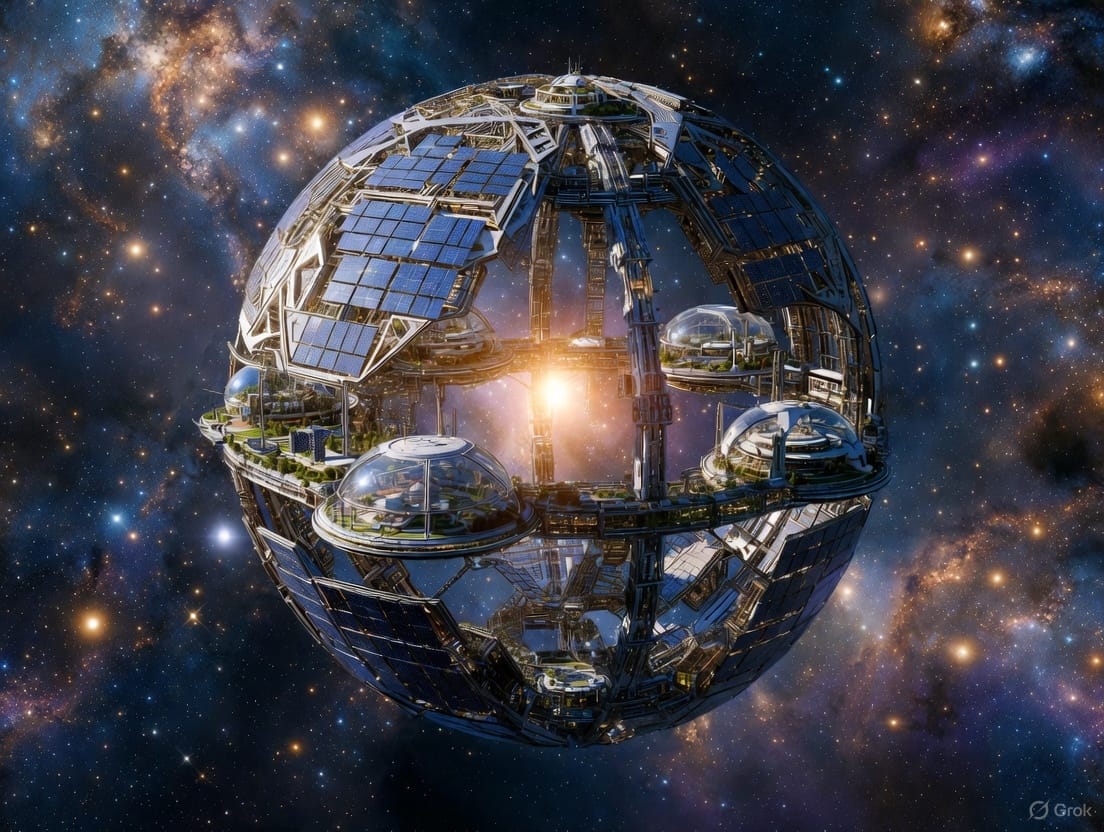
| II | Stellar civilization | Energy of an entire star | Builds megastructures around its star (e.g., Dyson spheres) |
| III | Galactic civilization | Energy of an entire galaxy | Controls billions of stars and black holes |
There are also proposed Type IV (universal) and Type V (multiversal), but those are still science-fiction territory.
Where Is Humanity Right Now?
We are not even Type I yet.
Carl Sagan calculated a more precise formula in the 1970s, and when we plug in today’s numbers, humanity is roughly at:
Type 0.73 – 0.74
That means we’re getting close to Type I, but still far from mastering our own planet’s energy.
Here’s a quick comparison of energy numbers:
- Current global energy use: ~20 terawatts (2 × 10¹³ watts)
- Type I (planetary power): ~10¹⁶–10¹⁷ watts – about 10,000–100,000 times more than today
- Type II (one star): ~4 × 10²⁶ watts – a billion times more than Type I
- Type III (Milky Way): ~4 × 10³⁷ watts – another billion times more
How Close Are We to Type I?
If energy use keeps growing at historical rates (about 2–3% per year), some optimistic forecasts say we could reach Type I in 200–400 years. More realistic estimates (accounting for efficiency and population limits) push it to 500–1,000 years—or longer if we hit major setbacks.
What would a Type I civilization look like?
- Fusion power everywhere (clean, almost unlimited energy)
- Global weather control
- Mining the oceans and crust efficiently
- Possibly a united world government (or at least strong cooperation)
The Leap to Type II: Building a Dyson Swarm
Once we’re Type I, the next big jump is capturing all the energy of the Sun.
The most famous way to do this is with a Dyson Sphere—not a solid shell (that’s impossible), but a huge cloud of solar panels, mirrors, and habitats orbiting the Sun called a Dyson Swarm.
Timeline estimates:
- Optimistic: 1,000–3,000 years from now
- Realistic: 5,000–50,000 years (or more)
With that much energy, you could:
- Power trillions of people (or uploaded minds)
- Move planets if you wanted
- Travel or communicate across the solar system instantly
- Extend the Sun’s lifespan by feeding it hydrogen
Type III and Beyond: Lords of the Galaxy
A Type III civilization uses the power of billions of stars. We barely see any signs of them (the Fermi paradox), which suggests either they’re extremely rare—or they hide very well.
So What’s Next for Us?
Short-term (next 100–500 years):
→ Reach Type I by mastering fusion, space-based solar power, and planetary management.
Medium-term (1,000–10,000 years):
→ Colonize the solar system and start building the first pieces of a Dyson Swarm → Type II.
Long-term (100,000+ years):
→ Spread across the Milky Way → Type III (if we choose to).
Final Thought
The Kardashev Scale isn’t just about bigger power plants. It’s a roadmap of what might be possible if a civilization survives long enough and keeps solving problems creatively.
We’re still at the very beginning—less than 1% of the way to Type I—but every solar panel, every fusion experiment, and every rocket launch is a tiny step up the scale.
The future is vast, and the next few centuries will decide whether humanity stays a fragile Type 0 civilization… or becomes something truly stellar.
What do you think—will we make it to Type I in your lifetime?