The ECB's words move markets. Half of Europe isn't listening
The ECB's President moves interest rates almost as much with speeches as with decisions. Yet nearly half of Europeans say they hear nothing from the ECB.


At 14:15 Frankfurt time on a decision day, the European Central Bank (ECB) publishes a short press release. Thirty minutes later its President sits down in front of the cameras. Within an hour after that, traders across Europe have repriced trillions of euros of debt, and the interest rate on the next variable mortgage in Lisbon, Milan or Sofia has quietly shifted with them.
On 17 November 2026, ECB Executive Board member Philip R. Lane gave a seminar at Harvard titled "The practice and science of monetary policy communication." It received little attention outside specialist circles. Yet the fifteen slides he presented answer a question that matters to anyone who borrows, saves or gets paid in euros: how does a central bank steer an economy of 350 million people with words, and is anyone actually listening?
The ECB's own research gives a two-part answer. Financial markets hang on every sentence. Ordinary households, for the most part, hear nothing at all.
Twenty-seven years of talking about different things
The ECB has always talked, but what it talks about has changed completely with each crisis it faced. ECB staff analysis of every press conference, press release, meeting account and presidential speech since 1999 shows the shift clearly.
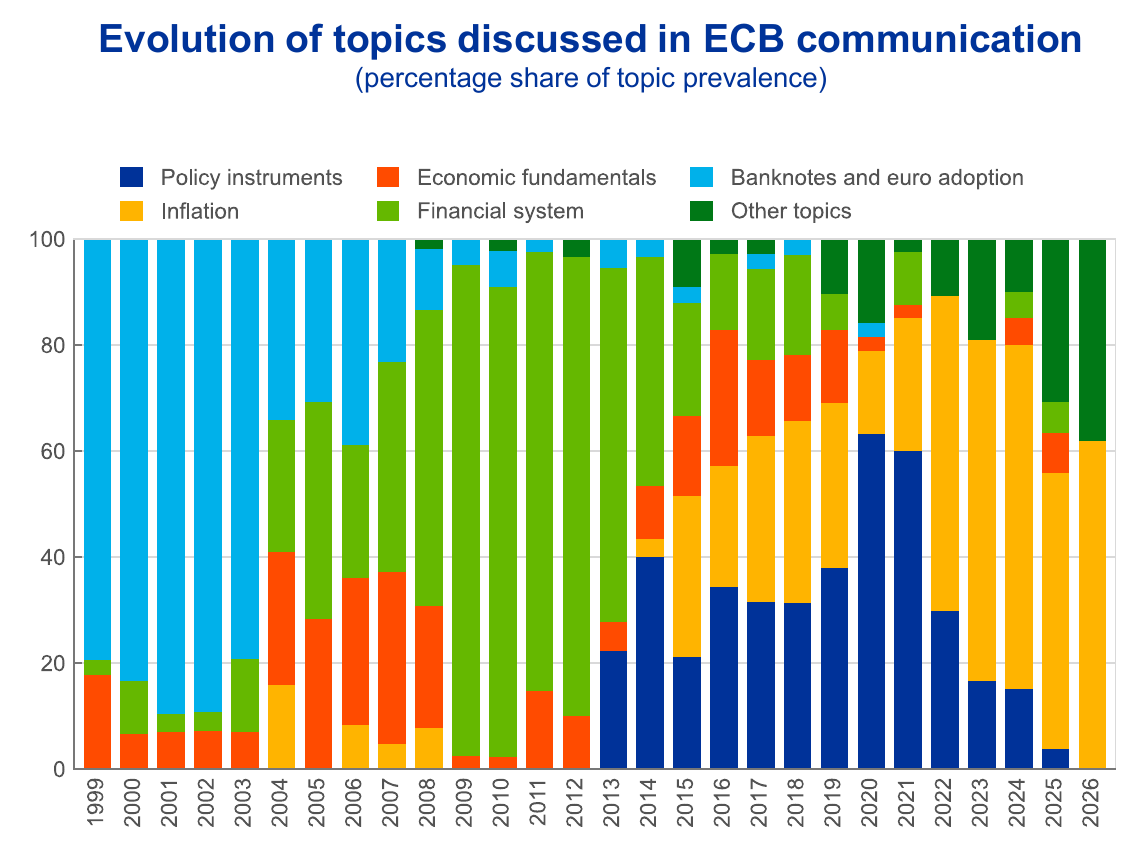
In its first years, the bank mostly discussed banknotes and euro adoption — the practical job of launching a new currency. From 2008 to 2013, the financial system crowded out almost everything else as the global financial crisis and then the euro area debt crisis threatened the currency's survival. From 2013 through 2021, the conversation was dominated by policy instruments: negative interest rates, bond purchases and the unusual tools the bank used while rates were stuck near zero.
Since 2022 the dominant topic has been inflation. In 2026 it accounts for roughly 60% of what the ECB says, with most of the rest falling into "other topics." The bank's vocabulary follows the problem in front of it, and the problem in front of it today is prices.
A carefully choreographed release cycle
Every six weeks, the ECB runs the same sequence of publications. Lane's presentation sets it out: the decision press release at 14:15, the press conference with the Monetary Policy Statement and questions at 14:45, the macroeconomic projections at 15:45 in quarters when new forecasts are produced, the Economic Bulletin two weeks later, and the "accounts" — an edited record of the policy meeting — four weeks after that.
Each layer has a job. The Monetary Policy Statement read at the press conference follows a fixed structure: an introduction that explains the decision and the framework behind it, followed by assessments of economic activity, inflation, risks, and monetary and financial conditions. The accounts summarise the staff presentations, the "monetary policy considerations and policy options," and the Governing Council's discussion.
The point of the routine is predictability. If the market knows what will be published, when, and in what format, it can focus on the content rather than guessing at the process. That predictability is also why the 27 members of the Governing Council — the six Executive Board members plus the governors of the 21 national central banks, including Bulgaria's since it joined the euro in January — are expected to keep their public comments within the framework the statement sets.
Speeches move markets almost as much as decisions
The most striking chart in the presentation measures how much interest rates move in the minutes around each type of ECB communication. The ECB's researchers added up the absolute moves in risk-free rates in tight windows around each event between 2004 and 2023.
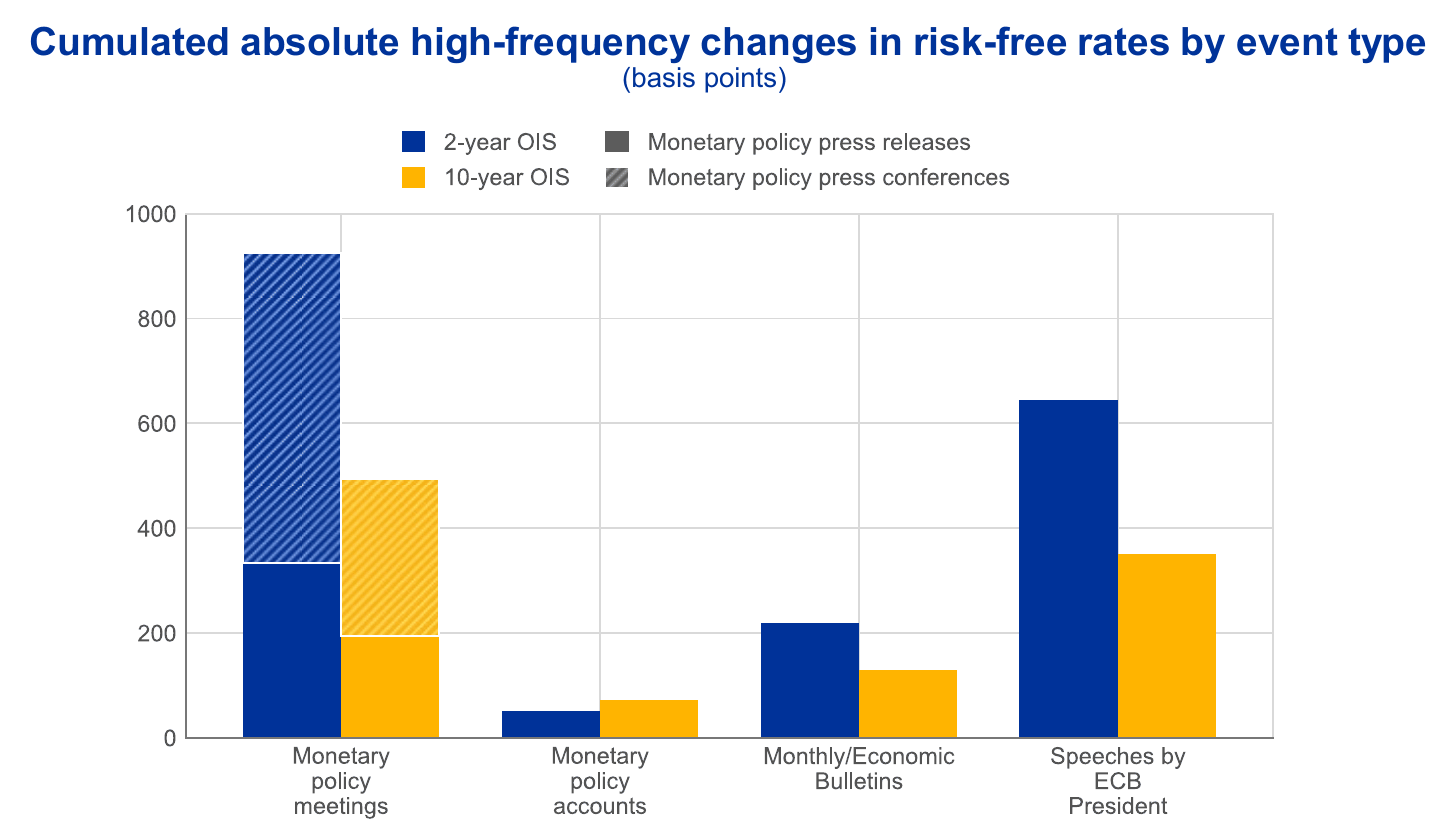
Policy meetings moved two-year rates by a cumulative total of roughly 925 basis points over the period. Most of that movement came during the press conference rather than at the moment the decision was published — the explanation moved markets more than the decision itself. Speeches by the ECB President added up to around 645 basis points, far more than the Economic Bulletins (about 220) and the meeting accounts (about 50).
One caution is needed here. These are totals, and the President gives many more speeches than there are policy meetings, so a single speech moves rates far less than a single meeting does. Even so, the totals show where the market's attention goes. Over two decades, what the President said between meetings shifted borrowing costs almost as much as what the Governing Council decided at them.
This matters for the months ahead. The ECB has confirmed that Christine Lagarde will step down on 7 February 2027, well before her term ends. Whoever replaces her will become, overnight, the single most market-moving speaker in Europe.
From promises about the future to a known rulebook
The harder question is how much the ECB should say about what it will do next. Lane's slides lay out the dilemma frankly. Before each meeting, ECB staff analyse a whole family of plausible future rate paths, and this analysis is valuable for the decision. Publishing those paths is a different matter. The projections are highly sensitive to model assumptions, including assumptions about what policymakers themselves prefer, and agreeing a promise among 27 people is difficult. Conditional guidance also carries the risk that markets ignore the conditions and treat it as a commitment.
The ECB's answer has been to focus public communication on the immediate decision and to explain the rules it uses instead of the path it expects. Since March 2023 it has said its decisions depend on three things: the inflation outlook, underlying inflation, and the strength of monetary transmission — how quickly and strongly its rate changes reach the economy. The 2025 update to its strategy added the "surrounding risks" as an explicit fourth criterion. Lane calls this "framework guidance": a public description of the reaction function, rather than a forecast of rates.
The bank pairs this with sensitivity and scenario analysis. Its staff projections show how the outlook changes if energy prices or the exchange rate move, and the published scenarios focus on concrete risk events: the pandemic, Russia's invasion of Ukraine, tariffs and the Middle East conflict. The aim is to let markets work out for themselves how the ECB would respond if one of these risks materialised.
Does the rulebook work? The market evidence
ECB staff tested this by measuring how strongly euro area interest rates respond to surprises in economic data under each communication regime since 2007.
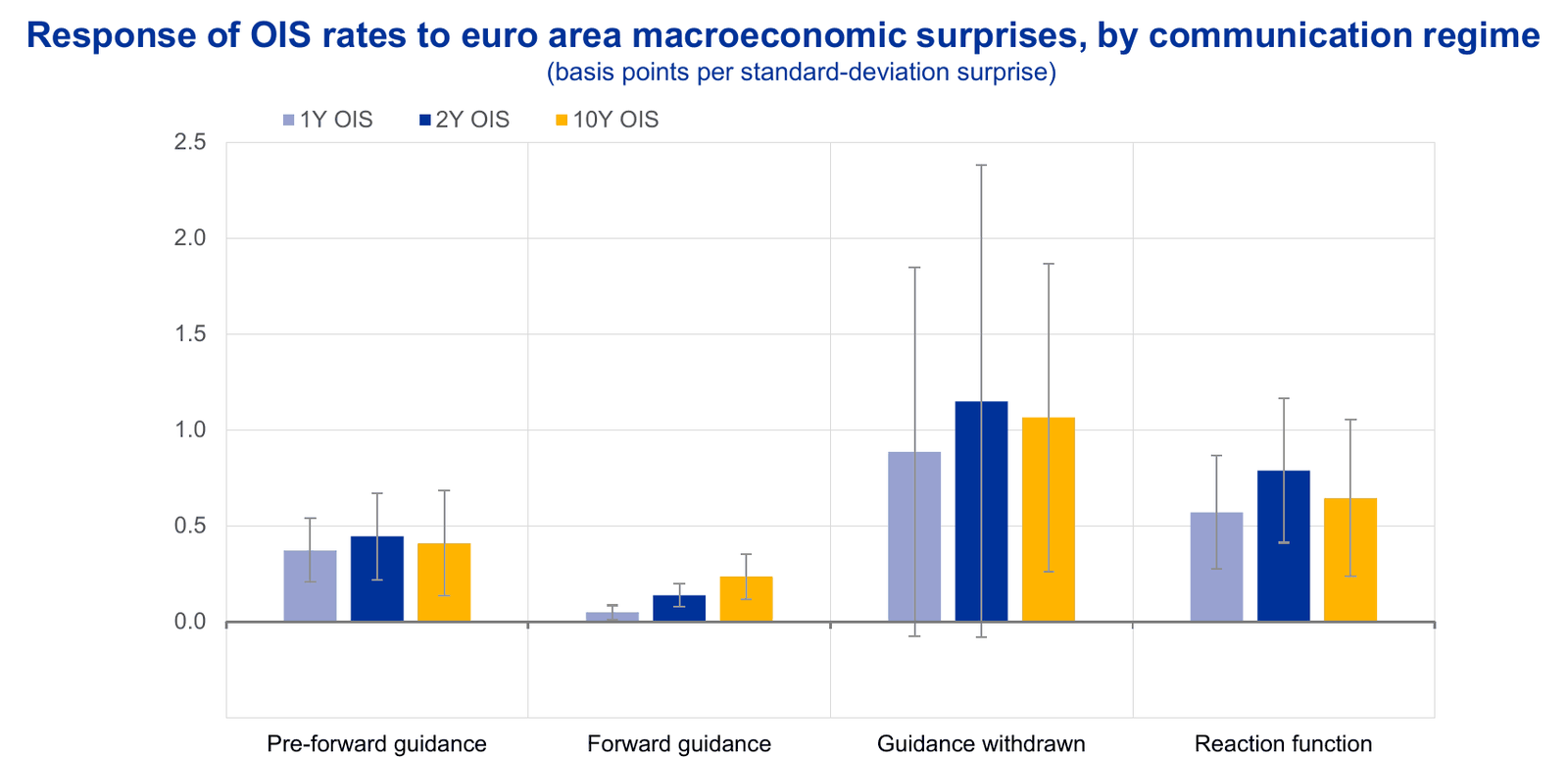
The pattern is clear. Under explicit forward guidance, short-term rates barely reacted to economic news at all — the ECB had told markets where rates were going, so data surprises hardly mattered. When the guidance was withdrawn, rates swung sharply, and the wide error bars show how uncertain that period was. Under the current reaction-function approach, rates respond to news in a moderate and more predictable way.
That is the intended result. If markets understand the rulebook, a bad inflation number should push expected rates up before the ECB says anything, because traders can work out the response themselves. Separate staff analysis of individual meetings supports this. During the chaotic 2022–2023 tightening, ECB meetings regularly delivered surprises of four to six standard deviations. During the 2026 hiking cycle, triggered by energy prices rising again, the surprises have been much smaller, and measured interest rate uncertainty has been lower. The ECB's data suggests markets have been anticipating its moves rather than being shocked by them.
The ECB has also started measuring its own tone. Using large language models to score thousands of texts as hawkish or dovish, its staff find that the bank's policy tone has followed a "Taylor-type" rule: about 80% of the weight goes to what it says about inflation and about 20% to what it says about economic activity. Since July 2022 the weight on activity has risen slightly, to around a quarter.
The most ambitious slide asks whether words alone change the real economy. ECB staff estimate that a shift in communication tone, scaled to have the same effect on short-term market rates as a 25 basis point rate rise, lowers consumer prices by a similar amount over two to three years. The rate shock hit industrial production faster and harder in the first year. The confidence bands are wide, so this is suggestive rather than conclusive, but the implication is significant: talk can tighten conditions with less early damage to output than actually moving rates.
The audience that isn't listening
All of this precision is aimed at a small audience. The ECB's Consumer Expectations Survey asks people across the euro area whether they have seen or heard anything about the ECB in the past two months.
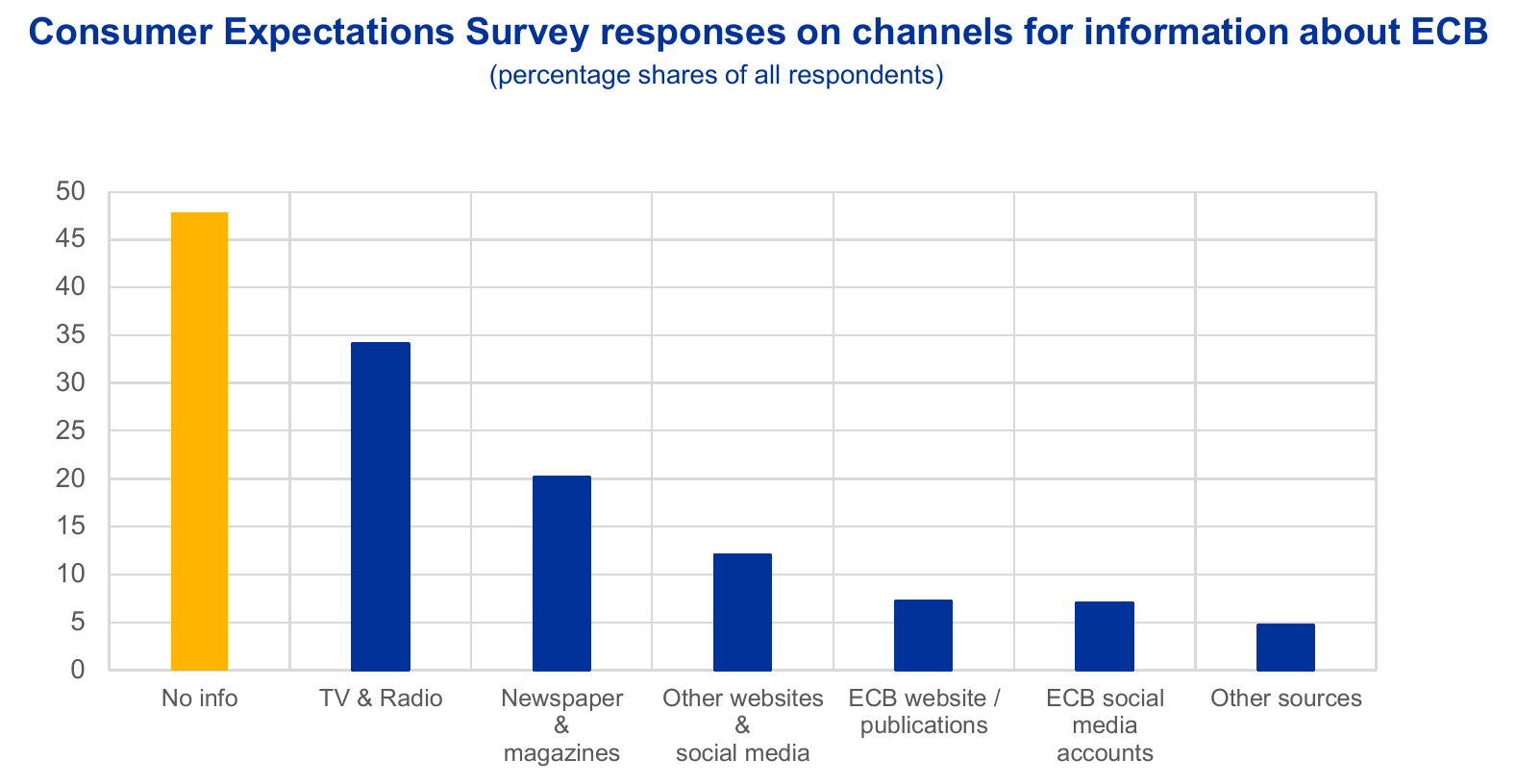
In August 2026, close to half of respondents — about 48% — said they had heard nothing at all. Among those who had, television and radio were by far the main source at around 34%, followed by newspapers and magazines at about 20%. Only about 7% got information from the ECB's own website or publications, and a similar share from its social media accounts.
In other words, the carefully structured statement, the calibrated framework guidance and the scenario analysis reach most households, if they reach them at all, after a journalist has compressed them into a thirty-second news segment.
Attention arrives when the damage is done
The other side of the household picture is when people start paying attention. ECB research tracking inflation coverage in the news shows that public attention to inflation is not constant. It rises sharply when inflation is already high.
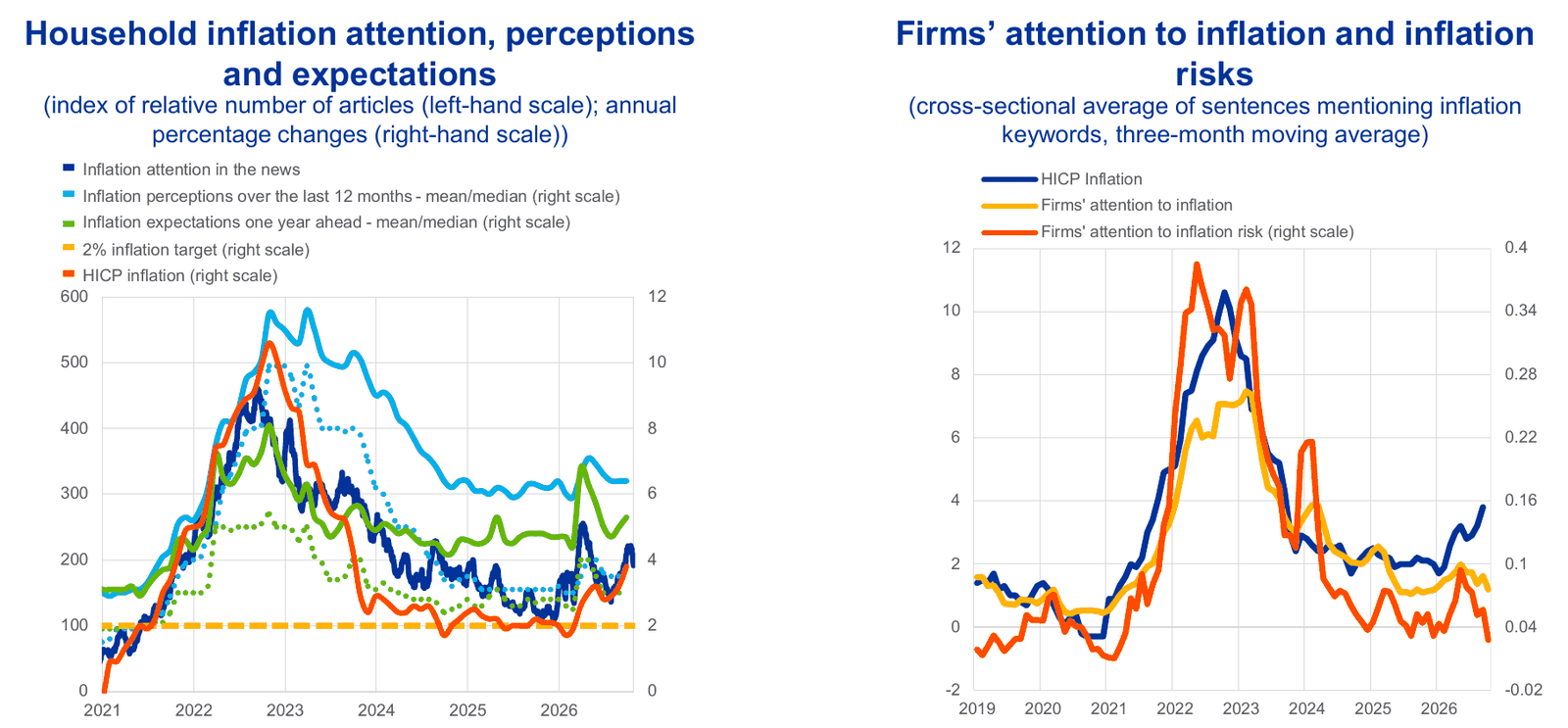
News attention to inflation rose several times over between 2021 and late 2022, moving almost in step with actual inflation, which peaked above 10%. As inflation fell, attention faded too. Companies behaved the same way: mentions of inflation in corporate earnings calls rose and fell with the inflation rate itself.
The more worrying detail is what was left behind. Households' perceptions of past inflation stayed well above actual inflation long after the peak, and in the latest survey data, average perceived inflation over the past year sits above 6% while average expectations for the year ahead are above 5%. Actual inflation was 3.8% in September. Both attention in the news and actual inflation have started rising again in 2026 as energy prices climb.
This is the central bank's real communication problem. People notice inflation when it hurts, form their beliefs at that moment, and then hold on to them. A central bank that cannot reach households in calm periods has to work much harder to anchor expectations once prices start rising again.
What it means for ordinary people
The ECB has built a sophisticated system for talking to markets, and the evidence suggests it works. Interest rates now respond to economic news in a way that tracks the bank's stated rules, and markets anticipated the 2026 rate rises rather than being surprised by them. For the roughly half of the population that never hears from the ECB, though, the system is invisible — and that half still feels its effects through loan rates, deposit rates and prices.
Three things follow for readers who want to stay ahead of decisions that affect their finances.
First, you do not need to wait for a rate decision to know which way rates are heading. The ECB has told the public what it watches: the inflation outlook, underlying inflation, how strongly its policy is reaching the economy, and the risks around all three. When those indicators move, market rates move with them, and variable-rate mortgages and new loan offers follow within weeks.
Second, the press conference matters more than the headline decision. The decision is usually priced in already. The explanation of the decision is what moves borrowing costs. If you are about to fix a mortgage rate or lock in a deposit, the thirty minutes after 14:45 on decision day are worth following.
Third, watch the leadership change. A new ECB President takes over in February 2027, and the market will treat their early speeches as new information about the reaction function. Periods of uncertainty about a central bank's intentions are when rates swing most, as the period after forward guidance was withdrawn showed.
The ECB's research makes one more point that applies well beyond central banking. Waiting until prices hurt to pay attention means forming your view of inflation at the worst possible moment — and then carrying that view long after conditions have changed.
For most of its history, the ECB's job was to be heard by a few thousand traders and economists. Lane's slides show a central bank that has become very good at that job and is only beginning to measure how far it is from the second one: reaching the people whose savings and loans it actually sets.