How a distant war reaches your savings: the ECB's May warning
A war closed the Strait of Hormuz, and the ECB's latest review traces how the shock travels through bond markets and shadow banks to reach your savings.


Somewhere in the back of the European Central Bank's May 2026 Financial Stability Review is a chart that does not look like much: a line tracking the number of ships passing through the Strait of Hormuz, the narrow channel beside the Arabian Peninsula that carries roughly a fifth of the world's oil. Through the first months of 2026, that line falls. By spring, traffic through one of the most important chokepoints on the planet has thinned out.
The European Central Bank (ECB) does not usually lead its flagship risk report with shipping data. This year it had to. The Review's opening message is blunt: an adverse geoeconomic shock is unfolding. A war in the Middle East has closed the strait, energy infrastructure has been hit, and global energy supply has been disrupted. The question the rest of the document quietly tries to answer is the one that matters to anyone with a mortgage, a pension, or a savings account — how does a war thousands of miles away end up touching your money?
The answer the ECB lays out reads like a map of plumbing. A shock enters at one end — tankers that stop moving, energy prices that climb — and travels through government bond markets, through the lightly regulated world of investment funds, and finally through the banks, before it reaches households as higher prices, tighter credit, and shakier savings. The Review is, in effect, a guided tour of how interconnected, and how fragile, that system has become.
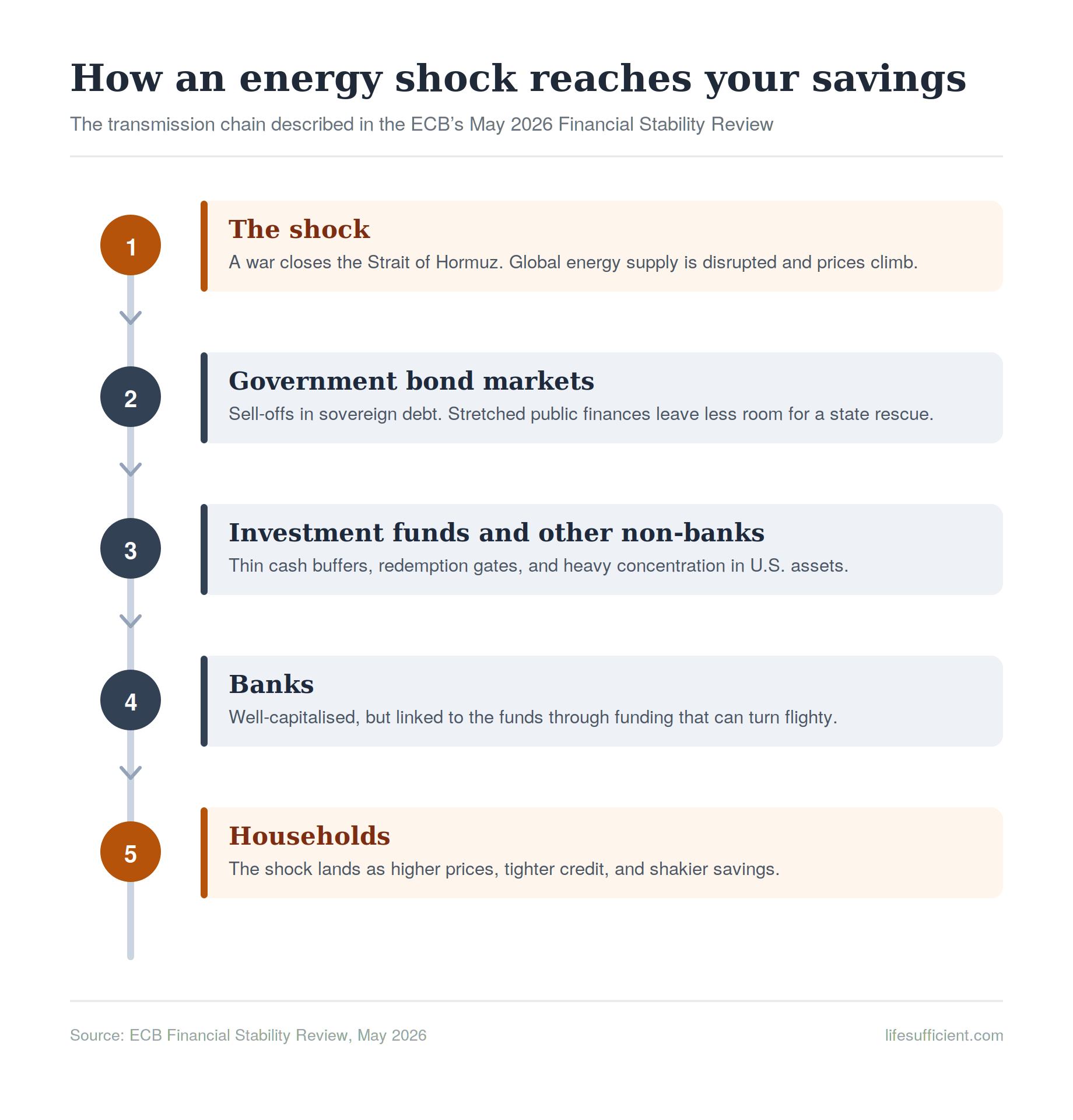
What the ECB means by "an adverse geoeconomic shock"
The phrase is central-bank language for something straightforward: a sudden, externally driven blow to the economy with no quick fix. The trigger here is a war the ECB dates to early March 2026 — its charts mark the first trading day after 28 February as the starting point. The closure of the Strait of Hormuz and the attacks on energy infrastructure cut into global energy supply, and the bank is honest that how bad this gets depends on how long the war lasts and how far it spreads.
You can see the shock in the ECB's own forecasts. The Review sets its February 2026 projections for euro area inflation and growth beside its May 2026 projections, and the outlook has moved in the direction an energy shock always pushes it: toward higher inflation and weaker growth at the same time. Economists have an ugly word for that combination — stagflation, where prices keep climbing while the economy slows. Between late February and mid-May, markets also repriced the likely path of interest rates as the new reality sank in.
The ECB is careful not to overstate the damage. It is not yet locked in. But the bank flags two things that could turn a contained shock into a spreading one: further disruption to international trade and cooperation, and the ever-present risk of cyberattacks — the quiet danger that a conflict fought partly online could strike financial infrastructure directly.
The shock landed on a system that was already stretched
The war did not hit a calm market. It hit one that was already nervous, which is why the ECB devotes so much of the Review to vulnerabilities that existed before the first tanker turned back.
In the months before the war, market jitters were mostly about artificial intelligence — specifically, worries about whether the enormous bets on AI would pay off. The ECB tracks this through indices such as the UBS US AI Winner Index, a basket of 45 U.S. companies positioned to gain from the AI value chain. When the war erupted, the worry switched from AI to energy, and equity markets fell broadly. Then the selling spread into government bond markets.
Here is the part the ECB wants readers to sit with. Even after those declines, valuations still look stretched in most markets. The bank compares today's price-to-earnings ratios against the full range seen since 2005 and finds them high by historical standards. A market priced for perfection falls harder when something goes wrong, because there is more distance between where prices are and where the fundamentals would justify them being. The energy shock is the trigger. The stretched valuations are the dry tinder it landed on.
Channel one: government debt and the limits of a state rescue
The first place the shock travels is into the market for government debt, and the ECB's concern is that governments may have less room to cushion the blow than people assume. After the war broke out, there were sell-offs in sovereign bond markets — the bonds governments issue to fund themselves. The ECB notes that the market is still functioning in an orderly way, but it points to two pressures building underneath: a shifting base of investors holding the debt, and external imbalances in some countries' public finances.
The deeper problem is fiscal capacity. When a shock hits, voters expect the state to step in — to subsidise energy bills, support affected industries, soften the landing. The ECB warns that this capacity is limited in some countries because public finances are already stretched after years of crisis spending. A government that is already carrying heavy debt cannot borrow freely to rescue its citizens without spooking the very bond investors it depends on.
There is a contagion risk layered on top. The ECB notes that a fiscal slip-up, or trouble spilling over from one of the other major advanced economies, could trigger a global repricing of sovereign risk — investors everywhere suddenly demanding more to hold government debt. For an ordinary person, that abstract phrase has a concrete edge: the cost a government pays to borrow eventually feeds into the cost of everything from mortgages to the public services a budget can afford.
Channel two: the shadow banks and the private-credit question
The second and most detailed channel runs through what the ECB calls non-banks — the financial firms that are not banks but now hold an enormous share of the system's money. These are the pension funds, insurers, investment funds, and hedge funds where ordinary people's long-term savings actually sit. In the jargon, the sector is non-bank financial intermediation (NBFI), and the ECB's worry is that stress here could amplify a shock and spill across the whole system.
For now, the bank says, non-banks have held up. When the war hit, money flowed out of risky assets and into safer ones — a classic flight to safety — and toward bonds that protect against inflation. But the ECB sees structural weaknesses that could turn an orderly retreat into a disorderly one. Many funds run with thin cash buffers and a mismatch between how quickly investors can pull their money out and how quickly the fund can actually sell what it owns. If markets turn violent, that mismatch can force fire-sales and trigger waves of withdrawals. Pockets of high borrowing, especially among some hedge funds, can spread the damage further.
The ECB also flags a specific exposure that should make European savers pay attention: non-banks here hold concentrated piles of U.S. assets bought at elevated prices. That leaves them facing two risks at once — the assets could lose value, and the dollar could move against them.
The clearest warning sign in the Review comes from across the Atlantic. In the first quarter of 2026, U.S. private-credit funds saw unusually large redemption requests — investors trying to get their money out — that tested the funds' "redemption gates," the rules that can slow or suspend withdrawals during stress. The ECB explains the vehicles at the centre of this: business development companies (BDCs), which lend mainly to small and medium-sized U.S. firms. The non-listed versions promise investors quarterly withdrawals at full value, but reserve the right to lock the doors when too many people head for the exit at once — which is exactly what the gates are for.
Europe's direct exposure to these U.S. private-credit funds is limited, the ECB stresses. But it draws the line plainly: if confidence cracked and the damage spread to high-yield bonds, leveraged loans, and stock markets, the knock-on hit to euro area pension funds and insurers could be material. The Review devotes one of its special features entirely to stress in global private credit — a market that has grown fast, in the shadows, and that the ECB admits it cannot see into clearly. That blind spot is part of why the bank keeps returning to it.
Channel three: the banks, stronger now but tied to everyone else
The third channel is the banks, and here the news is genuinely better — with a catch. The ECB's assessment is that banking-sector resilience has strengthened overall. Euro area banks navigated the recent bouts of market volatility well, supported by strong capital cushions, ample liquidity, and healthy profits. Their direct exposure to the Middle East is small; the regional breakdown in the Review shows their largest foreign exposures are to the United States and the United Kingdom, with the Middle East near the bottom of the list.
The catch is that banks no longer stand alone. The ECB warns that rising financial-sector linkages mean stress in the non-bank world could spill back into the banks, mainly through funding. Banks increasingly borrow from the same investment funds that might suddenly need their cash back, and the Review notes that this funding sourced from non-banks could prove flighty in a panic. The walls between the regulated banking core and the lightly regulated rest of the system are thinner than they look.
There are real-economy pressures too. Banks with heavy exposure to trade-sensitive, energy-sensitive, and interest-rate-sensitive industries could see loan quality deteriorate if the war drags on. And the chain reaches households directly: the ECB warns that a cost-of-living shock, weaker-than-expected growth, and a softening labour market could erode some households' ability to keep up with their debts. One of the Review's special features examines exactly this tension — rising corporate bankruptcies set against loan books that have so far stayed resilient.
The AI thread running through all of it
One theme weaves through every channel: artificial intelligence has become a financial-stability concern in its own right. The ECB now treats it as a market vulnerability, not just a technology story. A handful of large U.S. AI-linked companies carry an outsized share of global equity values, which means the market has two separate triggers pointed at the same stretched prices — an energy war and the chance that the AI boom disappoints. The Review warns that investor concern about AI disruption or disappointment could strain the market segments most exposed to it, and notes that private markets are among the most exposed.
The bank has even turned the technology on itself. One special feature describes the ECB's shift "from dictionaries to AI" in reading financial-market sentiment — using machine-learning tools to gauge mood across markets faster than the old keyword-counting methods allowed. The watchdog is using AI to watch the risks that AI itself is helping create.
What it means for ordinary people
Strip away the charts and the Review tells a single story: a war became an energy shock, and that shock landed on a financial system that was already carrying stretched valuations, a fast-growing and opaque private-credit market, and a heavy concentration in a few U.S. assets. The trigger came from outside. The fragility was already in place.
For someone who is not a policymaker, the practical translation runs along four lines.
First, prices. An energy shock pushes the cost of living up while slowing the economy, which is the worst combination for household budgets — wages stretched thinner against bills that climb.
Second, savings and pensions. The ECB's sharpest warnings are not about the banks; they are about the funds. Your pension and insurance savings sit inside the non-bank system the Review keeps flagging, and the private-credit stress that surfaced in the United States this year is the kind of thing that travels.
Third, credit. If loan quality deteriorates and bank funding gets jumpy, borrowing becomes harder and more expensive — for businesses first, and for households soon after.
Fourth, the limits of rescue. Stretched public finances mean some governments have less room to cushion the blow than they did during past crises, so the automatic assumption that the state will step in deserves a second look.
A few things are worth watching in the months ahead: shipping volumes through the Strait of Hormuz and where energy prices settle; whether euro area government bond spreads stay calm or start to widen; any sign that fund redemptions or private-credit stress are spreading; and whether the AI-heavy parts of the stock market reprice. The ECB's own policy prescriptions — keep bank safety buffers in place, finish building the banking union, tackle leverage and liquidity risks among non-banks, and close the data gaps in private credit — are a fair guide to where it thinks the weak points are.
The one habit of mind the Review rewards is refusing to read "the banks are strong" as "the system is safe." The whole point of the document is that the danger has migrated to the parts of the system most people never see.
A map, not a forecast
A Financial Stability Review is not a prediction. It is a stress map — an honest accounting of where the cracks are before anything breaks. The ECB is not saying a crisis is coming. It is saying that a war it cannot control has pushed against a system that had quietly grown more fragile, and that the resilience carefully built into the banks since the last crisis can still be undone by weaknesses elsewhere. The line tracking ships through a distant strait and the line tracking the value of your pension are connected by a chain most people never have reason to trace. This year, the ECB traced it for us.