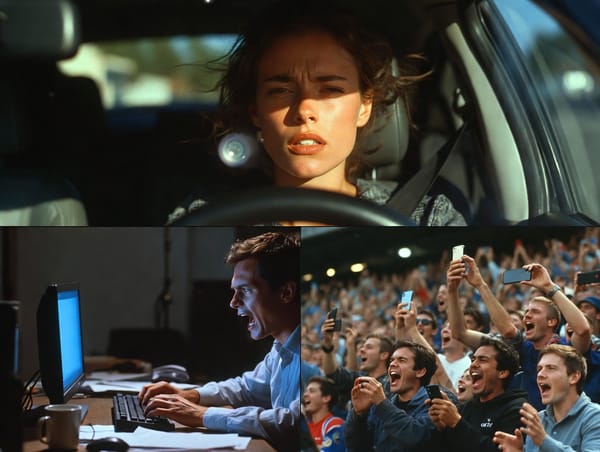
The Hidden Triggers
Discover how biology, implicit memory, and unmet emotional needs quietly shape your decisions — and build the awareness to choose on purpose.


You made dozens of decisions before breakfast this morning. What to wear, whether to check your phone, how long to linger in the shower — each one felt like a conscious choice. But neuroscience tells a different story. Research from the Max Planck Institute has shown that brain activity predicting a decision can begin several seconds before a person becomes consciously aware of choosing. Your biology, your memories, and your unmet emotional needs are quietly shaping the call before you even know you're making one.
Understanding these hidden triggers isn't about undermining your sense of agency. It's about upgrading it. When you can spot the unconscious forces at work, you gain something powerful: the ability to choose on purpose rather than on autopilot. Here's how these three layers of influence operate — and what you can do about each one.
Your Brain's Ancient Operating System
Beneath every modern decision sits hardware that was optimized for a very different world. Your nervous system still runs survival software written for savannas and small tribes — software that prioritizes immediate threats, quick energy, and social standing over long-term planning.
Consider the mid-afternoon sugar craving. You might frame it as a preference, but your dopamine system is doing the real negotiating. Recent research published in Nature Communications has revealed that dopamine doesn't just reward you after a good outcome — it actively builds what scientists call "behavioral attractors," pulling you toward actions that previously delivered a payoff. That craving isn't random. It's a well-worn neural groove your brain carved through repetition.
The same goes for stress responses. When a colleague's email feels like an attack, your amygdala is reacting at speeds your conscious mind can't match. The fight-or-flight system doesn't distinguish between a predator and a passive-aggressive Slack message. It just detects threat and mobilizes.
None of this makes you irrational. It makes you human. The practical move is to build a habit of pausing before reacting — not to suppress instinct, but to give your slower, more deliberate thinking a chance to weigh in. A useful question in these moments: Is this urgency real, or is my body running an old program?
The Weight of What You've Already Lived
If biology provides the hardware, your personal history writes the software. Every experience you've accumulated — the wins, the failures, the offhand comments that somehow stuck — creates filters that shape how you interpret the present.
Psychologists refer to this as implicit memory: information your brain stores and uses without your conscious awareness. Unlike the memories you can deliberately recall, implicit memories operate in the background. They influence your reactions, preferences, and avoidance patterns without announcing themselves.
A 2024 review in Frontiers in Psychology confirmed that implicit memory doesn't just affect simple motor tasks — it shapes social behavior, emotional responses, and even the judgments we make about other people. Your brain is constantly pattern-matching the present against the past, and when it finds a match, it triggers a response automatically.
This explains some puzzling behaviors. Maybe you consistently avoid conflict even when standing your ground would serve you well. Maybe you feel an unexplained warmth toward certain strangers or an irrational discomfort in specific environments. These reactions often trace back to experiences you may not even consciously remember.
The antidote isn't to psychoanalyze every feeling, but to develop a habit of curiosity. When a reaction feels disproportionate — too much dread, too much excitement, too much avoidance — treat it as a signal. Ask yourself: When have I felt exactly this way before? You won't always find the source, but the practice of looking loosens the grip of automatic patterns over time.
The Emotional Needs Running the Show
Beyond instinct and memory sits a third force that may be the most persistent of all: your unmet emotional needs. Humans are fundamentally social animals, and we carry deep requirements for connection, validation, autonomy, and meaning. When those needs go unrecognized, they don't disappear. They drive behavior from the shadows.
Think about the last time you agreed to something you didn't want to do. On the surface, it looked like generosity or team spirit. Underneath, it may have been a need for approval — a quiet calculation that saying no would cost you standing in someone's eyes. Or consider the late-night social media scroll. The conscious story is boredom or habit. The unconscious story might be a search for belonging, novelty, or reassurance that you matter.
Research into self-determination theory — developed by psychologists Edward Deci and Richard Ryan — has consistently shown that three core psychological needs drive human motivation: autonomy (feeling in control of your choices), competence (feeling effective), and relatedness (feeling connected to others). When any of these goes unmet, people tend to compensate in ways that don't always serve them well.
The practical skill here is naming the need honestly. Not the story you tell yourself about why you're doing something, but the emotional reality underneath. When you catch yourself overworking, people-pleasing, or compulsively checking your phone, try completing this sentence: What I actually need right now is _. Security. Recognition. Connection. Rest. Naming it takes away some of its covert power.
Building What You Might Call Trigger Literacy
Awareness of these three forces — biology, memory, and emotional needs — is valuable on its own, but it becomes genuinely useful when you turn it into a repeatable practice. Think of it as developing trigger literacy: the ability to read your own unconscious signals in real time.
Start with low-stakes decisions. Pick something routine — your morning coffee order, your reaction to a particular coworker, your evening screen time — and run a quick internal audit. Is this choice being driven by a physical state (hunger, fatigue, stress hormones)? A pattern from the past (habit, avoidance, comfort-seeking)? An emotional need (approval, control, connection)?
You won't always get a clear answer, and that's fine. The point isn't perfect self-knowledge — it's building the reflex of checking. Over time, that reflex gets faster and more accurate. You start catching the trigger in the moment rather than only recognizing it in hindsight.
A practical tool that supports this is what cognitive behavioral therapists call the ABC model: identify the Activating event (what happened), the Belief it triggered (what you told yourself about it), and the Consequence (how you felt and what you did). Writing this down even a few times a week can reveal patterns that are genuinely surprising.
Turning Awareness Into Intentional Action
Spotting your hidden triggers is half the work. The other half is using that awareness to steer rather than just observe. This doesn't mean overriding every instinct or ignoring every emotion — some of your automatic responses are perfectly good. It means having a reference point to check them against.
That reference point is your intention. What kind of life are you building? What matters to you when you strip away the noise? When you're clear on your direction, you have a filter for evaluating the unconscious nudges as they arise. A craving can be indulged or redirected. A fear can be respected or gently overruled. An emotional need can be met in a healthy way rather than a reactive one.
The key distinction is between reacting and responding. Reacting is automatic — trigger to behavior with no gap in between. Responding involves a pause, however brief, where you notice the trigger, consider your options, and choose deliberately. That pause is where your freedom lives.
This isn't about perfection. You'll still eat the cookie, send the impulsive text, and avoid the difficult conversation sometimes. The difference is that over time, you'll do these things less often by default and more often by choice — and that shift changes everything.
Practical Takeaways
Here's what to carry forward from all of this:
- Your biology isn't your enemy, but it is your default. Learn to recognize when hunger, fatigue, or stress hormones are making decisions for you, and build in a pause before acting.
- Your past shapes your present more than you think. When a reaction feels outsized, get curious about where the pattern started. Implicit memories lose influence when you drag them into the light.
- Unmet emotional needs drive more behavior than most people realize. Practice naming the real need underneath the surface-level story.
- Trigger literacy is a skill, not a trait. It develops through practice — start with low-stakes decisions and work your way up.
- Intention is your steering wheel. Decide what you're building, and use that clarity to evaluate the unconscious nudges as they come.
The goal isn't to eliminate these hidden forces. They're part of what makes you adaptable, intuitive, and human. The goal is to know them well enough that they work with you rather than without your knowledge. That shift — from unconscious passenger to informed driver — is one of the most practical upgrades you can make.